Sovereignty in Love- Knowing When to Stay or Leave with Ken Blackman & Manon on The Healers Café
In this episode of The Healers Café, Manon Bolliger, speaks to Ken Blackman who discusses the dynamics of breakups, highlighting that anxiously attached individuals often initiate them. Blackman advocates for building relationships that provide mutual support, especially during challenging times, to foster long-term happiness and health.
Highlights from today’s episode include:
Ken explains Chemistry vs. intimacy: A great relationship needs both spark and the safety to be fully yourself, not constantly “protecting the vibe.”
Ken explains Healthy breakup: A loving split sounds like “I see you, I get what you need, it’s valid—but it’s outside my range,” with mutual respect, grief, and relief.
– – – – –
Manon explains Real freedom: What feels most free is not many partners, but being completely yourself—“weirdness” and all—with one person who truly gets you.

ABOUT KEN BLACKMAN:
A former Apple engineer turned relationship mindset coach and intimacy educator, Ken Blackman is currently celebrating his 25th year helping couples co-create a thriving, fulfilling life partnership and a gourmet love life. His work has garnered mentions in Business Insider, Playboy, Tim Ferriss’s 4-Hour series, Cosmopolitan, and elsewhere. He’s a regular featured contributor to The Good Men Project, Better Humans, and his own Medium publication, The Craft of Intimate Coupledom.
Core purpose/passion: I think my superpower as a relationship coach is to be a translator and help them see and understand each other. I tend to listen and ask, listen and ask, until I feel like I see the world through one partner’s eyes. Then I do the same with the other partner, listen and ask until I see the world through their eyes. Then I help them see each other. Sometimes translation; is just saying to one partner exactly what I heard the other say, but as though I’m speaking to the most important, honorable person in the world, whom I have the highest regard for.
– Facebook | Instagram | Medium | Website | BlueSky | Threads
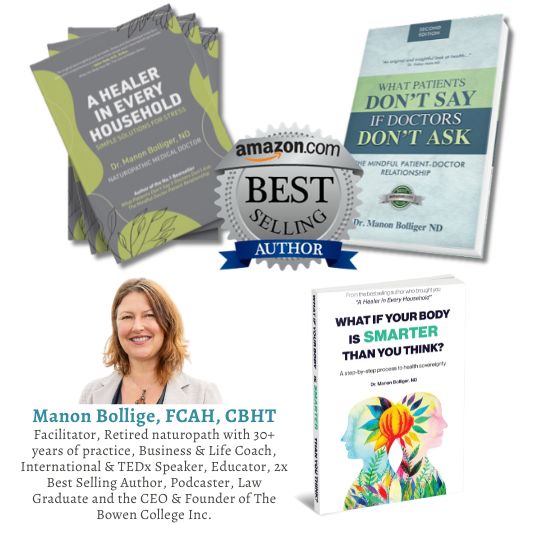
ABOUT MANON BOLLIGER, FCAH, RBHT
As a recently De-Registered board-certified naturopathic physician & in practice since 1992, I’ve seen an average of 150 patients per week and have helped people ranging from rural farmers in Nova Scotia to stressed out CEOs in Toronto to tri-athletes here in Vancouver.
My resolve to educate, empower and engage people to take charge of their own health is evident in my best-selling books: ‘What Patients Don’t Say if Doctors Don’t Ask: The Mindful Patient-Doctor Relationship’ and ‘A Healer in Every Household: Simple Solutions for Stress’. I also teach BowenFirst™ Therapy through Bowen College and hold transformational workshops to achieve these goals.
So, when I share with you that LISTENING to Your body is a game changer in the healing process, I am speaking from expertise and direct experience”.
Mission: A Healer in Every Household!
For more great information to go to her weekly blog: http://bowencollege.com/blog.
For tips on health & healing go to: https://www.drmanonbolliger.com/tips
SOCIAL MEDIA:
– Linktr.ee | Rumble | Gettr | Facebook | Instagram | LinkedIn | YouTube | Twitter |
About The Healers Café:
Manon’s show is the #1 show for medical practitioners and holistic healers to have heart to heart conversations about their day to day lives.
Subscribe and review on your favourite platform:
iTunes | Google Play | Spotify | Libsyn | iHeartRadio | Gaana | The Healers Cafe | Radio.com | Medioq | Audacy |
Follow The Healers Café on FB: https://www.facebook.com/thehealerscafe
Remember to subscribe if you like our videos. Click the bell if you want to be one of the first people notified of a new release.
* De-Registered, revoked & retired naturopathic physician after 30 years of practice in healthcare. Now resourceful & resolved to share with you all the tools to take care of your health & vitality!
TRANSCRIPT
Introduction 00:00
Welcome to the Healers Café. The number one show for medical practitioners and holistic healers, to have heart to heart conversations about their day to day lives, while sharing their expertise for improving your health and wellness.
Manon Bolliger 00:17
Welcome to the Healers Cafe today. I have with me Ken Blackman, and he his organization basically is about sovereignty in connection, and he helps indecisive couples either commit fully or separate amicably without fear or regret and and then those who go on, he helps them craft a thriving, loving, fulfilling life partnership. So I mean, that seems like a wonderful thing to do. You can’t lose. So what? Give us a little bit about your background and how you ended up in this field?
Ken Blackman 01:05
Yeah. So in my 20s, I was a software engineer at Apple, right? And I was relatively successful, you know, like most of my life was, I had friends, I had some spending cash, I did fun things, but I I was terrible when it came to relationships, just awful. Like I was bad in every way that you can, that you can, you know, think of I was codependent, I was misogynistic. I had nice guy syndrome. I was whiny and needy as a boyfriend, I was bad in bed, like you name it. I was just not I didn’t know what I was doing, and I needed the kind of help that I now offer to other people. Like I needed, like, support and coaching and mentoring and like how to have a healthy, intimate, mature, like fulfilling relationship with it, with another human being. And that was so transformative for me that I thought this is the work that I want to do. I want to help other people have, what, what, what I’m now experiencing with women. And so I left my career, and, like, studied with my mentors, and like, like, just did a deep dive into what it takes for people to have great relationships, and I’ve never looked back. This is what I’ve been doing full time for 25 years.
Manon Bolliger 02:36
Now that’s, you know, it’s a long time. If you weren’t going to have any doubt he would have stopped by now. So, yeah, so what? I mean, what does it take to know that you that you should get out of a relationship? Let’s start with that. Because I think a lot of people, you know, I mean, I have no direct couple relationship, you know, counseling or 30 years working with people. A lot of health issues come from their relationships, right from the things they can’t deal with, the stress that it has, the unresolved stuff, but they don’t, dare say, not standing up for themselves, like a whole bunch of things that give stress and affects your your health. So what, what have you found? Are they, maybe the main things that where people don’t they, they have a sense they should be a part, but they can’t do it. What are the the things that hinder this?
Ken Blackman 03:42
Yeah, I mean, wow, I could go in so many different directions. There’s somebody, but let me, let me start here. There’s probably a lot to talk about, but let me start here. There’s chemistry, which is, you know, like attraction and how it good, feels good to be with the other person. And then there’s like connection and intimacy, which is your ability to be yourself. So if you so a lot of people who have chemistry, what they’re what they find is that they it feels really good. And then they’re really protective, like they don’t want to say something that’s going to kill the vibe. You know, they start to present them their best self, and, and they’re doing a lot of management to have it feel good. Do you know what I mean? Yeah, yeah. And, and then there’s intimacy and connection, where, really what feels good is, can you be yourself with this human being, like, are you able to be yourself? And hopefully you have both, because if you have ..
Read more...
chemistry, like, if you’re going to be in a long term relationship, people don’t really understand. Transition from we’re dating, where you you’re doing, you’re on your best behavior, to what it takes to create a life partnership like a real you. This is the person you want to do life with. If you haven’t transitioned into you can really, really be yourself with this person. If you’re still like, trying to protect the vibe. If you’re still trying to, like, like, you know, juice, juice, the chemistry, that after a while that’s that’s going to be tiring. And people say, I just like, I, you know, they’ve been in the relationship for a while, and they, they kind of feel like they, they need some time alone. They need to get away all that stuff. That’s because they have a relationship where they can’t actually be themselves,
Manon Bolliger 05:46
right? Right? Yeah, makes it so
Ken Blackman 05:49
ideally, what you what you want, is to be able to have both. But that takes courageous honesty, like think about the things that you are most afraid to share with your partner, because you’re afraid, like the things that you are most afraid, if they knew this, they would want to leave. That’s the stuff that you need to share in order to get into this deeper territory where you’re genuinely, truly connected with this person. This person has your back there. You know that they’ve chosen you, not some facade like this is you’ve chosen each other to be like your your most important person in your life. You don’t want to spend the rest of your life with someone that you have secrets from, have to put on, put on a mask with, or that you have to hide something from so it takes this very courageous level of honesty to get into that territory, but we all hunger to have that kind of person, that person who’s who’s really our person. So no
Manon Bolliger 06:55
make sense? Because if you’re ultimately, if you can’t be yourself, it’s just too much work, or if you’re on eggshells, or, I mean, I’ve been a few relationships, so I can tell, you know when, when, finally, I’m comfortable. I am. I myself, I do, you know, sometimes weird things, but it’s me, and it’s really fine. I think that’s like, it’s so much nicer than, yeah, then that sort of in between, but then you also need the chemistry. So what? How do you like? So let’s say you’re starting new with somebody, and you get along. The vibe is right? You you’re, you know, there’s a lot of people that are faster now to be more themselves. It’s becoming more popular than it was. But would How do you explain chemistry and does chemistry disappear? Does it in your mind? How does it work? Is it something to also work on? Or is it always there? Or can you,
Ken Blackman 08:03
you know, I yeah, there’s this belief that, you know, like a good like people crave variety, or that they crave novelty, especially in the bedroom. I haven’t found that to be the case at all. I actually think, when you’re really, when you’re really connected with someone and honest with someone, and you can talk about things, you can actually craft a love life that’s better than what you can find. You know you can, you can have craft it to be better than what you can find. So the example that I can imagine a couple who decide that they’re going to have they’re going to have dinner together a couple of nights a week. They’re going to make dinner together and just enjoy, enjoy a meal together a couple of nights a week. So you know, first you have to figure out what’s your dietary restrictions. What’s your dietary restrictions, what do you love to eat? What do you love to eat? And they may not perfectly match up, but you figure out, how do we make a meal where both people are getting up totally happy with the meal, right? That’s totally possible. Then, you know, you’ve got, you’ve got your meals dialed in. Then you start to experiment with different cuisines. You get better. You get your flow in the kitchen, you know, like, one person’s really good cooking the steak, no one’s really good, you know, roasting the asparagus. You know, you you learn to start experimenting with different flavors and different you know, like, well, let’s try this. We haven’t made this recipe. You start to play with recipes, and you start to like, make recipes your own. But you’re, each time you’re talking about the experience, you’re saying what you like you what you don’t like, you’re like, really relating over the meal, right? You’re not just like, picking a recipe in silence, cooking in silence, you know? Right? Eating in silence. You’re talking, you’re like, you’re relating over what’s enjoyable. So after a few years, those meals are going to be dialed in, because, because you’ve been working together, you know? So your your love life can be that way too. So that’s, that’s how I think about it, like the best of what relationship can offer, the best chemistry, the best juice, the best you know. The best of it is, when you’re with someone who knows you so well, they know what feels good to you. They know what right way. They know you so well. They can anticipate. They can like, flirt. They can like, there’s, there’s this dynamic between two people who know each other really well, that, I think, is the best of what’s of what’s possible, not knowledge, not, you know, right variety,
Manon Bolliger 10:50
yeah, yeah, no, I would concur, you know, but it’s, it’s true, that it’s really a belief out there, not, I don’t think, I mean, I don’t know, maybe that’s not true. No, I’ll take that back. I’ve heard it more from from men, but I, I, I’m now hearing it also from women who start to believe that that’s true, because so many are not, you know, planning to really settle down, not have kids, all this business. So they think it’s a freedom, you know, but I don’t know that that’s really freeing. It’s more freeing to really get to know yourself fully and be with another, you know. So yeah,
Ken Blackman 11:34
there’s this, there’s this amazing quote from Joni Mitchell, oh, yeah, and she picked it up from a magazine article that she read. But basically, if you want the same experience again and again and again, keep seeing other people. If you want infinite variety, stay with one person. And the reason she says that is because when you first, when you first get with someone, you know you’ve got your stick, you’ve got your moves, you got, you know, like the stories you haven’t told them yet. You know you like all this stuff that’s new, right? And pretty soon you’ve gone through all your best your all your best moves, all your best stories, all you know. And at that point you know each other, and you actually have to break into new territory together, and you have to talk about stuff you’ve never talked about before. You have to, like, get to know each other at a new level, like, that’s when the relationship begins. The, you know, the really good stuff begins after you’ve gone through all of your your tricks and your sticks and your you know, then, then the possibility of something new that you’ve never experienced before is possible.
Manon Bolliger 12:50
No, I yeah, I would think that that is true. It’s, I mean, I’ve experimented so many things based on belief systems. You know, when I I saw that, you know, so many people so called cheated. I thought, well, I’ll never be in a relationship like that, because I don’t believe in that. So I’m going to call it an open relationship, and therefore it’s allowed, and therefore it’s not cheating anymore, you know, and and in some ways, theoretically, at the time, many years ago, 40 plus, anyway, it felt completely right. It felt it felt like freedom. But it wasn’t freedom. In the end, it didn’t feel that, yeah, it’s like you couldn’t go further with one even though you might be more attached to one person. It’s like, no what? Why? Why am I not developing all of it? And you know, why am I not addressing that original feeling or that fear, you know, that I would be cheated on, or whatever it is that, you know, yeah, it’s funny.
Ken Blackman 14:07
You should bring that up. I practiced like being in open relationships for years myself, yeah, and what, what we liked about it was, I’m not going to tell you what not to do with someone else in order to have what you want with me.
Commercial Break 14:26
What would your life be like if you were pain free? If you were one of the millions who suffer from chronic pain? The thought of just one day without it may seem impossible. This is often because conventional medicine tends to fall short in the treatment of pain, opting to prescribe pills or recommend surgery rather than getting to the root cause of the problem. But if you are suffering with emotional or physical pain, there is hope. Join the founder and CEO of Bowen College, Manon Bolliger. Live online for your body, mind reboot, learn how to listen to your symptoms and get to the root cause of your pain, plus be trained in basic bow and therapy moves so that you can reboot your body for optimal health. You don’t have to live in pain. You can heal, stop the pain pill cycle by visiting www.yourbodymindreboot.com to learn more and to register
Ken Blackman 15:36
like, I’m not gonna You don’t have to limit what you have with someone else in order to have everything, like I care about how the two of us relate. Do you know what I mean? So there was this great freedom and not limiting each other and not shrinking each other in order to have something. And what, what I found was that over time, there got to, you know, if you’re really developing with, with one person, you get to a place where it’s like, oh, this. I don’t really want anyone else. Like, I’m, I’m really liking what we have at home, you know I mean, like, I don’t feel drawn to anyone else because I, I’m really digging what, what we’ve got. That’s, that’s where you can get to with that, you know what? I mean, yeah, it isn’t. It isn’t. It isn’t building a moat around yourself. No, no, exactly No. Get in. It’s, it’s crafting something with someone that that just feels amazing
Manon Bolliger 16:35
in where I’m at now. It’s, it’s actually the most freeing of all relationships, and I’ve been doing this one for 20 years, and it’s we. We talk completely freely, and I’m totally free, but there’s absolutely no desire by either of us, you know. But there’s the freedom juice and and it’s sort of, it’s almost like there’s so much fun developing and, like you say, new territory, things that, well, I haven’t had to look at this situation, or what it’s like to deal with someone in pain, or what it’s like to deal with trauma resurfacing, like you can go so deep and learn so much, like both partners, right? Then it’s like, why would you want to? You know, it’s not, it’s not even fun. But when I think about it, oh, what’s it’s fun to meet new people a little bit and then, but it doesn’t really like, I’d rather go back and be home. You know, that’s the feeling.
Ken Blackman 17:42
Now, I know that’s how I feel too. Sometimes I’m going to spend the rest of my life getting to know my wife like that’s that is a lifelong process of getting to know this person, yeah, yeah, letting her see more parts of myself. And, you know, yeah,
Manon Bolliger 17:59
right, because you’re allowed to discover it. That’s the other part, right? You know, it’s like, What’s it like having grandchildren? What kind of grandparents are you? You know, would you prefer, you know, traveling or spending time there? How committed like, you know, what? Who comes first? You know, all these things that you know, you kind of, you know, yeah, we were all smiling at each other, going, Wow, I’m looking forward to having the night with nobody around. How weird, you know, because I’m such a family person, I would never, ever have thought that I would actually be, you know, happy, completely wonderful, right? That’s ecstatic, yeah, but I like the idea that when you’re in something that’s not quite right, you know? I mean, there’s all the blame games and all that, but let’s say you have a higher consciousness, and you know that it’s not about that. It’s just partially you’re not being who you are. Yeah, and so there’s triggers, something else is attracting you that maybe you’re working through but you don’t want to work through all the way. So it’s stuck. The relationship isn’t growing. It’s how do you part that amicably? So what? What is it that you see that when people do it properly, what happens for Yeah, for
Ken Blackman 19:27
you, yeah, which is interesting, because, you know, some some couples that I work with do end up breaking up, and what’s funny is that they still send me, you know, referrals, because they’re so grateful for what they learned and having made a decision that they feel good about. And I can tell you what it sounds like. I’ll tell you what it sounds like when you it sounds like this. I totally see you, I totally get you. I understand what it is that you’re asking for. For, and I don’t think there’s anything wrong with what you’re asking for. It’s just out of my range, or it’s not something that I’m it’s not something I want to do. And I also feel like, I feel like you understand me. You under you. I don’t think there’s any you know. You understand what it is I’m asking for and what it is I want, and I respect that you don’t want to to. You know, it’s out of your range to give me what I’m asking for, or you don’t want that. So, you know, I have regret that, that we’ve come to this, this impasse. You know, I love you dearly and and I am mourning the life that we’ve had. I’m also celebrating if that we’ve had, and frankly, I feel a sense of relief, along with all that, that we’ve come to a decision and word deciding to move on with our lives. And I’m excited for my next chapter. I looking, you know, I hope you have your your next chapter is going to be good. And so that’s what it can sound like when you really have realized it’s not a good match. Is you both understand each other. You both understand what the other one wants, and you know that it’s not what’s what’s going to work for you.
Manon Bolliger 21:24
But I mean, with that, both have to be at a fairly conscious level, right? Because if I look at earlier breakups, you know, I can’t say either way. You know, I face my part of being unconscious, as has the other. But I think it’s yeah, it it’s like I my questions would be, well, couldn’t I? Couldn’t I compromise that? Or couldn’t I change that? Is that, you know, isn’t that such a is that such a big deal. I totally get it. Why can’t I blah, blah, blah, right? You know, isn’t that stuff something, at least, you know, from one of the partners, do you see that a lot,
Ken Blackman 22:10
or the sense that you, you, you do, but, but the thing is, like this kind of gets into the question of whether our relationship is, quote, worth it, which is a whole topic unto itself, worth it. You know what I mean? And I do see people trying and trying and trying and trying, trying and bending themselves into a pretzel. Do you know what I mean? Like pretzeling themselves to try and make it work. But the well, that’s that is getting further and further and further away from, you know, that’s more that’s more addiction than it is love. That’s more code codependent, yeah,
Manon Bolliger 22:56
yeah, no, I guess that’s a good point. Yeah, yeah. When you’re constantly bending, it’s like you’re you’re too afraid to just say, No, whatever it might be, and no, I don’t want to move you across the universe, or, you know, or I have children here, or whatever the story might be. That are a value system significant enough, right?
Ken Blackman 23:23
If someone believes that they are unlovable, it’s going to be very scary to leave a relationship, right? Yeah, if someone understands that they are lovable and that they are worthy and that there’s, you know, there’s plenty of opportunity to find someone else like if they’re if they like themselves, if they love them, they don’t have a hard time believing that someone else can like them and love them, right? And it becomes easier to say, I love what we have here, but there’s something that I want more that I’m not getting here. And so this isn’t good enough. This isn’t enough from like, the good, the good here isn’t good enough for me to want to stay and compromise this thing that I actually hunger for, that I’m not getting here, right?
Manon Bolliger 24:10
Yeah, that makes sense, yeah, yeah, yeah, yeah, you better get there, yeah. But that’s what I mean. It takes a certain consciousness to realize that you’re, you know, you’re not in a where you’re that it could be a codependent relationship, right? Yeah, yeah. So have you ever dealt with codependent relationships that the one of them might be super attached to making it work, the other one is potentially ready to move on? How do you deal with them?
Ken Blackman 24:39
Well, it’s funny. So, you know, there’s, there’s this talk these days about attachment styles, right? And so there’s anxiously attached. And often someone who’s anxiously attached will be in a relationship with someone who’s avoidantly attached. For some reason, the combination. Happens a lot, yeah, but the truth is, on a practical level, the anxiously attached one is actually the greater flight risk. They’re the they’re the ones that are like so we’re literally anxious that about whether this relationship is going to work and trying so hard, they’re actually usually the one that calls it first and says, This isn’t this isn’t working for me. So when? So that that finding really surprised me, because you you know, no, the person who has the most fear of abandonment is more likely to leave than the avoidant one. The avoidant one just has their walls up, right?
Manon Bolliger 25:52
Yeah, I guess what makes sense, yes. But usually,
Ken Blackman 25:55
when the breakup happens, it’s the it’s the anxiously attached one who does the breakup because they can’t stand the they can’t stand the the indecisiveness. They can’t stand the partner having their walls up. They can’t stand not being not having connection. They can’t stand their partner running away. They like they they just get fed up with it, right?
Manon Bolliger 26:20
Yeah, yeah, it does actually make sense. We can break it down a bit more than it would be more of a trigger, yeah, interesting. So we have like, five minutes left, and I realized I’ve just been sounding it a question. Is there something you would like to share right off of, you know, and then also how, how people can get hold of you. How do you work? Do you have any, yeah, you know, books that people can get, or articles, or how do people find out about you? Just maybe, you know, take the last
Ken Blackman 26:54
one, you know, there again, they’re like, I could talk for 18 or 20 hours about something, but I think what, given what we’ve talked about so far, I want to leave your your audience, with this thought, when your life is good, you know when times are good, when things are going well in your life in general, it’s really easy To be in love and have it feel wonderful, and then when things get hard, when it’s when life itself is challenging, like I live in Chicago right now and it’s challenging to be in Chicago right now. Oh yes, I can imagine so. So whatever it is, if you’re like when your life is challenged, yes, you are going to learn something about your relationship, because either you’re going to be thinking, this is really a difficult life situation, and I am so glad to be going through this with you. I am so glad I have you by my side during these challenges times, or your or your partner is going to feel more burdensome. Like they’re going to feel like, you know, wow, I have all this stuff I’m trying to deal with in my life, and now I have to deal with you too, like, you know, it could feel like your partner is, is, is a burden, and you’d be better off without them. So that tells you something about the health and vitality of the relationship. And so what you want to do, everything we’ve been talking about, is what it takes to build that relationship, the kind of relationship that feels like, you know, times are really tough, and I am so grateful I’m not alone. I’m so grateful doing this together. You know, all the stuff we’ve been talking about, it’s is for, for that kind of relationship?
Manon Bolliger 28:50
Yeah, well, it’s a really good point, because, I mean, there’s always stressful periods, and there’s general stressors in life, but I think to many people. The last four or five years has been very stressful and, and it’s, it’s brought some people apart because of fundamental differences in in belief, you know, and, and then you know, if you’re the tin hat boiled person or the oddball, that whatever stands up, you know, it’s going to bring you a hell of a lot closer. If your partner is on the same page and you’re like, Thank God there’s peace, otherwise you feel like you’re having crazy right? So I think this can really, yeah, it can make the relationship even closer, because it’s a tough time to stand up, endless, you know, yeah, interesting.
Ken Blackman 29:51
Now, as far as, as far as how to reach me, I’ll give you a URL to my blog. No, like this is, this is where. You can really read more about me, and you can find links to to reach out to me if you want support or coaching. So it’s Ken blackmon.medium.com, Ken blackman.medium.com, great.
Manon Bolliger 30:17
And then we’ll have it also written on the website and everything, so people can get hold of you. Well, thank you. That’s a lot of information in a short half an hour, but I think we covered quite a bit. I’m sure there’s so much more.
Ken Blackman 30:32
Thank you so much for having me on. It’s been a great yeah, no,
Manon Bolliger 30:35
I find this, you know, fascinating, and all of these aspects impact health. Okay, thank you.
ENDING:
Thank you for joining us at the Healers Café. If you haven’t already done so, please like, comment and subscribe with notifications on as I post a new podcast every Wednesday with tons of useful information and tips for natural healing that you won’t want to miss.
Continue your healing journey by visiting TheHealersCafe.com and her website and discover how to listen to your body and reboot optimal health or DrManonBolliger.com/tips.
* De-Registered, revoked & retired naturopathic physician, after 30 years of practice in healthcare. Now resourceful & resolved to share with you all the tools to take care of your health & vitality!