Living Boldly Beyond a Diagnosis with Stacy Scarcella & Manon on The Healers Café
Stacy Scarcella, a former corporate executive, transitioned to a creative entrepreneur after 13 years in fashion, advertising, and technology. Diagnosed with Marfan Syndrome at 25, she faced significant challenges, including legal blindness and potential infertility. Despite a grim prognosis, Stacy pursued self-care, research, and adaptive activities like Zumba and yoga. She emphasized the importance of self-advocacy and resilience. Stacy also works in mental health advocacy, particularly for adolescents, highlighting the need for early intervention and support. Her journey underscores the value of creativity, freedom, and positivity in overcoming health challenges.
Highlights from today’s episode include:
Be your own health advocate and move one step at a time: When she was diagnosed with Marfan Syndrome at 25 with a very grim prognosis, Stacy chose not to stay stuck in fear. She did her own research, sought multiple opinions, adjusted her lifestyle, and focused on “What can I do right now and one minute forward?” rather than catastrophizing the future.
Create freedom and possibility by redefining your path: Leaving a “boxed-in” corporate career, Stacy built Plaid Pony Productions around freedom: choosing diverse projects, not being tied to one creative partner, and continually pivoting (Zumba, yoga, events, mental health advocacy). Her core mindset
– – – – –
Bedside manner and medical ‘fashion’ can shape a patient’s fate: Manon highlights how the way a diagnosis is delivered can deeply harm or help a patient. She compares it to her own experience of being told she “needed” a C‑section because of narrow hips, only to safely have a home vaginal birth after seeking many opinions. She stresses that practitioners must be conscious of their language and the current “fashion” in medicine, because patients often meet a diagnosis first as doom and gloom, with very little visible information about alternatives, self-care, and hopeful possibilities.

ABOUT STACY SCARSELLA:
For more than two decades, Stacy Scarsella has built a career defined by vision, resilience, and reinvention. A former corporate executive turned creative entrepreneur, Stacy spent over 15 years climbing the ranks in fashion, advertising, and technology working with industry giants such as Armani, Macy’s, Talbots, TJX Companies, and Bose. Her career trajectory pointed toward becoming a CMO, but the demands of corporate life, constant travel, long hours, and lack of fulfillment sparked a personal reckoning. In 2015, following a season marked by profound loss and transformation, Stacy traded boardrooms for the beaches of Los Angeles, where a moment of clarity reshaped her entire future.
That clarity became Plaid Pony Productions, a full-service production company known for its storytelling integrity, cinematic creativity, and world-class brand activations. From major commercial campaigns to experiential events, Stacy leads her team in producing standout work for global names including Disney, AT&T, and other Fortune 500 companies. Known for her strategic foresight and innate ability to forecast industry shifts, she’s built a business that blends artistry with operational precision delivering results that can’t be replicated by automation or artificial intelligence.
But Stacy’s story runs deeper than her professional accomplishments. Diagnosed with Marfan Syndrome at 25 and told she might never have children or live past 40, she defied every prediction. Today, at 43, she’s a mother of two, a mentor, and a passionate advocate for mental health awareness and suicide prevention causes close to her heart following the loss of her best friend. Her philosophy, “Why not?”, defines her approach to both business and life: embracing creativity, curiosity, and courage in the face of uncertainty.
Beyond the studio, Stacy is a creative force in every sense an artist, yoga enthusiast, avid gardener, and dual citizen of Italy who finds joy in simple rituals like family dinners and dancing in the kitchen. Through speaking, consulting, and community initiatives, she now helps others humanize their brands in the age of AI, teaching entrepreneurs how to connect authentically and lead with purpose. Her work, both on and off the set, is a testament to her greatest belief: that success is not about control it’s about creating a life that feels deeply alive.
Core purpose/passion: My philosophy is: “Why not?”, and it defines my approach to both business and life: embracing creativity, curiosity, and courage in the face of uncertainty.
– Facebook | Website | LinkedIn | Instagram – Stacy | Instagram – PladPony
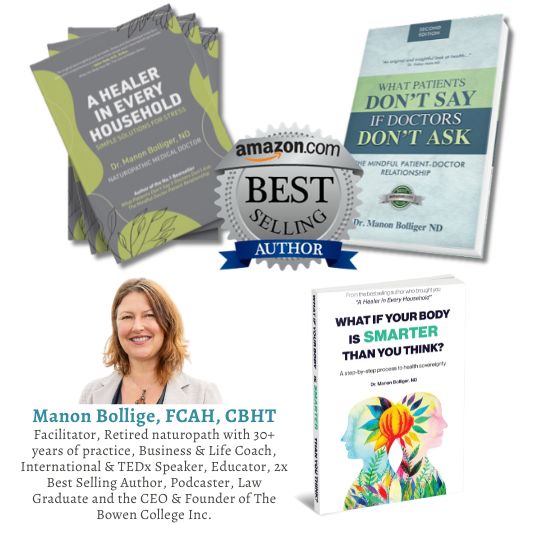
ABOUT MANON BOLLIGER, FCAH, RBHT
As a recently De-Registered board-certified naturopathic physician & in practice since 1992, I’ve seen an average of 150 patients per week and have helped people ranging from rural farmers in Nova Scotia to stressed out CEOs in Toronto to tri-athletes here in Vancouver.
My resolve to educate, empower and engage people to take charge of their own health is evident in my best-selling books: ‘What Patients Don’t Say if Doctors Don’t Ask: The Mindful Patient-Doctor Relationship’ and ‘A Healer in Every Household: Simple Solutions for Stress’. I also teach BowenFirst™ Therapy through Bowen College and hold transformational workshops to achieve these goals.
So, when I share with you that LISTENING to Your body is a game changer in the healing process, I am speaking from expertise and direct experience”.
Mission: A Healer in Every Household!
For more great information to go to her weekly blog: http://bowencollege.com/blog.
For tips on health & healing go to: https://www.drmanonbolliger.com/tips
SOCIAL MEDIA:
– Linktr.ee | Rumble | Gettr | Facebook | Instagram | LinkedIn | YouTube | Twitter |
About The Healers Café:
Manon’s show is the #1 show for medical practitioners and holistic healers to have heart to heart conversations about their day to day lives.
Subscribe and review on your favourite platform:
iTunes | Google Play | Spotify | Libsyn | iHeartRadio | Gaana | The Healers Cafe | Radio.com | Medioq | Audacy |
Follow The Healers Café on FB: https://www.facebook.com/thehealerscafe
Remember to subscribe if you like our videos. Click the bell if you want to be one of the first people notified of a new release.
* De-Registered, revoked & retired naturopathic physician after 30 years of practice in healthcare. Now resourceful & resolved to share with you all the tools to take care of your health & vitality!
TRANSCRIPT
Introduction 00:00
Welcome to the Healers Café. The number one show for medical practitioners and holistic healers, to have heart to heart conversations about their day to day lives, while sharing their expertise for improving your health and wellness.
Manon Bolliger 00:20
Welcome to the Healers Cafe, and today I have with me Stacy Scarcella. And for more than two decades, Stacy has built a career defined by vision, resilience and reinvention. So basically, a former corporate executive turned into a creative entrepreneur, and I’ll have Stacy explain a little bit more what she was doing, but basically climbing the ranks in fashion, advertising and technology, working with like Armani Macy’s tablet, TJ companies And boss and and then, yeah, and then something changed, and I wanted you to just take it from there and explain your this transformation. And also, you know how the condition that you didn’t talk about, Marfan Syndrome came to your attention and did it impact you? Did anything change because of it? Or were you just always meant to be? Stacy,
Stacy Scarsella 01:28
I love it. Well. Thank you so much for introducing me. It’s such a pleasure to be here and talk with you today. Yes, I have, you know, had a very amazing career, and it’s still going, and it’s ever changing, and I’m always pivoting and moving and shifting. I was in corporate because that’s what you do. You go to college, and then you get a job and you follow the rules, and I was a great rule follower, and I had incredible mentors and teachers that really guided me into, you know, getting into corporate and after 13 years of, you know, really working hard at different companies that, you know, some of the ones that you mentioned, I realized that I wasn’t truly fulfilled. And what does that mean? I mean, I think when you get to a place of, you know, in your career, where you think, Oh, I can go to the next level, but every single level I went to, I wasn’t filling that void. And, you know, I had some traumatic experiences in my personal life that helped me lead to that, for sure, but that was the that was when I decided to leave corporate and move my family across the country and start my own company. And I had to learn everything from scratch. I did not know the first thing about opening a company, and so everything was self taught, reaching out to people I knew. And now I’ve been running my company. I’m I’m in my 11th year, and it’s been really a fun, incredible journey.
Manon Bolliger 03:18
And so what is it you do now, and what is making it more creative, or what is it that gives you that fulfillment at this point?
Stacy Scarsella 03:28
Absolutely so I am a producer, and that’s really been my overarching title. Through all of my roles and all of my positions, I produce, I take a creative idea and I make it come to life in the simplest explanation of the word producers tend to be a title production, you know, and in itself is ambiguous, you can there are so many different types of producers. I specifically work in advertising. So I take campaign briefs and RFPs, and I turn them into a physical shoot or strategy to actually bring an idea to life. And so my company, plaid pony productions, we take in RFPs and we look at the bid itself, we create the bid, and most of our projects are triple bids, and when we win the project, we work closely with the director and the photographers to execute the concept from, you know, paper to the real shoot, and then we edit and help with the post and deliver. And so some of the projects are we We handle everything from soup to nuts. Sometimes we just shoot the content and we we do a data dump of files, and the client handles everything in house, or, you know, we are part of the pre Pro or just the post. And so there’s all different ways I’ve been brought into projects over the years. We also. Have a side of the business that does experiential events, and that’s basically a commercial in real life. So that’s why, that’s why I describe it. So I work with brands to bring a concept to life, whether it be a pop up shop or an experience or an event, but the business itself is a B to B business. Okay?
Manon Bolliger 05:22
So, so both of them, you’re doing something creative, but what? What is it that made you feel better about doing it on your own and being an entrepreneur without knowing anything about that
Stacy Scarsella 05:44
great question. When I worked at corporate, I really was I had to work on the projects I was assigned, and there wasn’t a lot of diversity in the projects. You know, I would just be working on tech, or I would just be working on fashion. And part of what I love about advertising is it is so expansive. You could be working on something with beauty and the next day telecommunications. And so when I built the company, I wanted to make sure that I had as much freedom as possible. So freedom is definitely the the theme of what gave me the confidence to make that jump. And when I started, I had a lot of directors come to me and photographers, and they wanted me to represent them, but part of me having freedom was not being tied to one concept. And so I flipped the script a little, because that’s not the traditional way production companies are set up. You are usually ..
Read more...
paired with a creative and we source unsigned and independent creators for all of our our projects. And it gives me that flexibility and freedom. And so when I left corporate, it was a box, and I wanted to open the box and have it as wide as possible. And so that’s what’s been so fulfilling over the last decade, is I am never bored. I am working on Fashion One day, the next day, a tech product that hasn’t launched yet, and then the day, a day after that, I’m working on some fashion brand, or I’m working on a health product. It is so fun because every day is a different type of project.
Manon Bolliger 07:33
So I’m in the parallel creative I think you had in both, but in really it’s the freedom, freedom of creativity and creativity. Yeah, so I just, I’m just curious, because, you know, according to your bio, you were diagnosed with Marfan, which, you know, if you read the diagnosis, it’s pretty grim. And you know, there’s a lot of things that are you know that if you absolutely were mortified by it, you would, you know, see yourself at some point having a heart issue, absolutely no children and all kinds of, You know, physical disadvantages. Let’s call it that way. That is not your story. So what was your attitude towards, you know, shifting, wanting to be creative, looking for freedom during a time where, you know, a lot of people would be in panic and in fear with their diagnosis. What do you see like you know, we’re we become who we are by the challenges we we face and the things that we learn from, at least on some level, I believe, you know. So what can you share you know to an audience that might be challenged with some diagnosis where they’re, you know, feeling quite stuck, definitely uncreative about it. And, yeah, so what? What happened with you? What? What did you do? Or it’s
Stacy Scarsella 09:16
an interesting journey, because it was, for sure, a shock when you’re 25 years old and you’re going in for support, because I had struggled with so many different types of of ailments over the years. And I was a caf I was a college athlete, I was very active, and the last thing I ever thought was wrong would be a heart condition and everything else that comes with Marfan Syndrome. It’s not just the heart that it affects. It affects everything. I’m legally blind in my right eye, and I had no idea that was tied back to the same syndrome that affected my. Back and my knees and my wrists and my my rib cage. I mean, so many different things. And when I was diagnosed, I was only 25 and it was a fairly new, you know, discovered syndrome. I mean, it’s not mainstream. To this day, many caretakers and providers and doctors don’t even they have to go back and Google it. It’s just not something that is as mainstream as some other conditions. And when I found out the doctor that was telling me she really didn’t have amazing bedside manner, and she was just like, well, you can’t have kids. You may live till you’re 40. Good luck and pretty intense. And I was by myself because I didn’t, I didn’t know I would be receiving these, this news, and so I left pretty shell shocked. And you know, it was the beginning of a lot of you know, self work to say, Okay, I have two choices here. I can dwell in my diagnosis that was told to me by someone I barely know, or I can do my research and continue to live my life. Obviously, there were some things that needed to change immediately, and that was, you know, how I worked out, how I, you know, was stayed physical, and that was all just part of, like a checklist of do’s and don’ts. Everything outside of that, I had to figure out myself. And this was not during, you know, I didn’t have a great, you know, AI partner with me. I had to, you know, read books and and research and call different doctors to figure out, okay, well, can I have kids? And you know, a lot of them said no, because, you know, the second trimester is when your aorta heart really expands, and even before then, and depending on, like, your body, and so if I was to dilate that part of my heart, I would have a massive heart attack. And so I did not think I could have kids, and I was dating my now husband, and he was so incredibly supportive. And I think that is a huge part of why the ride itself was easier because of my partner and we went to so many different doctors together. We weren’t engaged, we were not family planning, but he knew I needed that to move forward, because I needed information, and I I kind of accepted the fact that okay, I won’t have kids, that’s okay, that’s not in my cards. So I got to that place, and five years later, or two years later, we were married. We actually got married, and then we started living our lives together. We traveled all over the world. We were like, This is amazing. I mean, okay, we might not have kids, but we’re going to have all of these memories, and we weren’t sure if we wanted to adopt or anything in the future. We were still so young. But then I I got pregnant when I was 30, and it was a surprise, and I went to the doctor and I said, you know, how do I have to make a really hard decision today? And I had been keeping up with my cardio appointments, and they were like, your heart looks amazing. I think we should try to get you through this pregnancy. And that was the that was a shock, right? Like, I did not think able to carry my own baby or even have a child. And so I was high risk, even at, you know, 30 years old, I was a high risk, very I saw the doctor one to two days a week. So there were a lot of appointments, a lot of testing, and I made it through the pregnancy. And it was such a success that I just, I think, the universe around me. I mean, who knew that it was possible, but it’s because I truly did. I just said, why not, and that’s kind of in my motto over the years, why not. So I’m going to pause there, because I know you have
Manon Bolliger 14:17
no no I’m listening very attentively, but so why not? But before the why not, you were you were really doing an information search and as unbiased as possible. In other words, anything to give you more insight and your your focus, if I’m getting this right. Was self care. How do I manage this? You know, the best so I can have the best life possible.
Stacy Scarsella 14:50
Well, and I think that’s what’s so incredibly important. When you receive any health news that may not be positive, you have to take a. Breath and say, Okay, well, the sun will come up tomorrow. I’m still alive. What can I do with my time and be an advocate for yourself? That is the biggest thing that I’ve seen throughout my years. You know, even with other friends that have had very hard, you know, diagnosis cancer, MS, like different types of ailments, and you really do have to do your own research. I mean, the doctors are only they’re only going to share so much information because they do not have the time to spend with you and their 1000s of other, you know, all of the other people that need help. And so just having that information and in front of you, that information in front of you gives you the tools you need to decide what to do next. You know, what is your next step? I mean, and this is something I tell my kids and I live by, how can I focus on right now and one minute forward, that’s it. That’s all you can do when you’re really stuck in confusion or you know, or or just going through sadness because you’re you’re grieving a side of your life that is gone right because now you have this new information and you have something that you have something that you have to deal with and and I think that’s really powerful to just say, okay, what can I do right now? Me, that’s it.
Commercial Break 16:33
What would your life be like if you were pain free? If you were one of the millions who suffer from chronic pain, the thought of just one day without it may seem impossible. This is often because conventional medicine tends to fall short in the treatment of pain, opting to prescribe pills or recommend surgery rather than getting to the root cause of the problem. But if you are suffering with emotional or physical pain, there is hope. Join the founder and CEO of Bowen College, Manon Bolliger, live online for your body mind reboot. Learn how to listen to your symptoms and get to the root cause of your pain, plus be trained in basic Bowen therapy moves so that you can reboot your body for optimal health. You don’t have to live in pain. You can heal, stop the pain pill cycle by visiting www.yourbodymindreboot.com, to learn more and to register
Stacy Scarsella 17:42
what nobody else included. How do I move the needle? How do I move forward? Because you have two choices. You can stay where you are, or you take the step forward into whatever direction you’re going, but you at least move right.
Manon Bolliger 17:58
Yeah, no, it’s, I think that is the key I was. It made me think back a little bit to so I used to have, I used to be very, very skinny, which is has changed over the years, but my hips were very narrow. And at the time, I was in in Montreal, and I went to an obstetrician, and they said, Oh no, you’re going to need a cesarean. There’s no way that a baby can get through because I was pregnant and get through hips like that. So I went. I didn’t give up. I went because I thought, like, this is ridiculous. Have they never gone to Japan or China, or like any other country, I just thought, this is I, you know, sure, I’m skinny, but I’m not that skinny, you know. Like, there’s something wrong here, you know. So I went to eight different people, and I basically got the same one opinion and, and that kind of woke me up. It’s like, Gee, you know, it’s like, fashion. You know, if it’s mini skirt time and you ask what to wear, they’ll say a mini skirt. But when it’s just above the knees or just below the knees, that’s what you’re going to be told to wear, right? And I saw sort of medical procedures and advice in the similar way, right? Because it’s wasn’t the time. It was the fashion to have Cesareans anyways, though I didn’t want one, and I didn’t feel like a natural body needed to do that. That’s an emergency measure, right? So, of course, I had a home, you know, birth. I had vaginal everything was fine, and I got a midwife. I mean, a lot of decisions were made because of the small mindedness or the fashion at the time, right? So I, you know, I shifted, just like when you’re saying later, you know, you went to another doctor many years later, and they’re looking at a. A new reality is like, wait a minute, this heart is looking really good. Why don’t we try, you know? And it’s like, it changes, right? Like it
Stacy Scarsella 20:09
really does. And I had to create. I had another one. I mean, I’m blessed with two beautiful sons. And yes, the second pregnancy was hard, and it was a reason. We were like, Okay, we tested, you know, we further. We definitely had a very stressful pregnancy. And you know, both of us are lucky to be alive, you know, my son and myself, but we did. We made it right. And it’s also knowing when to cut your losses right. You might, you might be like, Okay, I’m going to go research and find out what I need to do, but also give yourself grace to accept that you might not be the exact same as the person sitting next to you, right? Because you have this different type of body that’s diagnosed the way it’s diagnosed and and I love your story, because I think that’s, that’s it. You know, if there, if you when there’s a will, there’s a way, right? And when I first find found out, I was a bit I worked out every day. I was very active. I was, you know, I played college basketball, so I wanted to continue staying active, and I didn’t know what else to do. And there was a cardio dance class that was being offered at my gym. And I always thought those were the people that just don’t they’re not athletes, right? They’re just, like, in there, just dancing around the little aerobics movement. And I took my first Zumba class, and this was in 2006 so it wasn’t like, a a big wasn’t really a big deal yet, yeah, and I loved it, and I was able to keep my heart rate up at a stable because my my workouts had to change, right? I couldn’t do hit classes. I couldn’t do high, low intervals like before, no more burpees, no more hard, intense workouts. But that doesn’t mean I can’t get my heart rate up and keep it up for 30 minutes, 45 minutes, however long. And so I started my Zumba, and I went and decided to get certified. I took in it full head first. I’m six, three. I do not dance. I wasn’t not a dancer, and I why not. And I went and got certified to teach Zumba classes because I loved it so much. And I did that for, gosh, five or six years, until I was pregnant, and so I stopped teaching, but I kept going to classes all the way through, and just this morning, I went to a Zumba class. So I still dance, and I still love it. It’s such a great way to move your body and keep your heart rate up. But I would have never, ever, ever fallen into that class and continued that incredible, weird journey of, hey, I was a Zumba instructor on, you know, amongst itself, and it was so fun, and it just has brought so much joy to my life that, if I had never, you know, and that’s the other thing. It’s like your path is your path. And when you have these bumps in the road with your health, look at it as an opportunity to explore something that you and I know that’s hard when you’re you’re going through really, really tough news, but you know it’s you got to start somewhere, right?
Manon Bolliger 23:36
Yeah, yeah, yeah. And you get opportunities, or you get, you get to see them as opportunities, eventually,
Stacy Scarsella 23:44
eventually, yes, in the moment, it can be really
Manon Bolliger 23:47
like Zumba, oh, my God, I’m never gonna do that, you know? And then, right, yeah, very interesting. And it’s, it’s, I can, I mean, I think of all the stories I’ve heard it really is like that. The key is to to sort of stay in the moment and and take the next step. Don’t get stuck, you know, because the moment is the past. The moment it happens, right? And if you’re stuck more in the past, about what it could mean you’re, if you’re doing the coulds and the shoulds and the woods, you’re not actually actively moving the very next step, right? And I think that’s it’s very important to do, you know?
Stacy Scarsella 24:37
Well, I think it continues to change right, like after I had children, my hips, because of my condition, never pulled back in. And so I had massive, you know, I have major si issues, and my hips pop like you wouldn’t believe. I mean, it’s, it’s, you know, fascinating how your body can change and shift. Left. But with this syndrome, I have, you know, have this extra level of, you know, discomfort that I’ve that natural childbirths. So I had to revisit, right? Okay, what do I do now? And so I got into yoga bodies, and I really started to build my pelvic floor and really try to figure out, okay, this is what my body’s doing. Now. What do I do? Okay, I might not be able to run anymore like I used to, because I used to love running, and it just things change, especially as you get older. And I think that has been fascinating. Again, another pivot, and I now have this incredible yoga community that I’m part of. I’m I have a yoga event coming up on Monday. I love putting together events for other women and people that may be struggling as well with okay, what do I do now? You know, and it can feel very frustrating when you think you’ve found a solution to a health situation, and then something else goes out right, like, Oh, now your ankle is hurt, or your shoulder or and with Marfan Syndrome, it affects ligaments and tissues. So guess what? Your whole entire body is full of ligaments and tissue. Yeah, so it’s and because of my my eyesight, you know, being legally blind in my right eye, as I’m getting older and I’m losing my eyesight and my left eye, it’s not great. It just makes me enjoy the moments even more to say, Okay, well, right now I can see, right, going to do as much as I can, and I value, I mean, gratitude. I mean, I know that’s something everybody’s talking about, right? Have a gratitude journal. Write down all the things you’re thankful for, but it is helpful. Right, focus on what you do have than what you’ve lost,
Manon Bolliger 27:03
right, right? Yeah. I mean, it changes your inner dynamic and how you perceive things in the end, right? Yeah, and that’s interesting. So one thing we didn’t talk about, I mean, there’s many things we haven’t talked about, but I’m trying to see where it was that you mentioned it, but you do work for mental health advocacy. Do you want to we have, like, a few minutes left, but I didn’t want to not talk about that. So if you could just share a little bit of what you do there.
Stacy Scarsella 27:40
Absolutely, when I was 33 and my son was barely two months old, not even I think he was five weeks old. Actually, my best friend committed suicide, and she was like a sister to me. And so not only was I going through, you know, I postpartum, and I had this newborn and I had a two year old, it was, it was a really hard time. So I was suffering just as much as some other, you know, obviously family and friends around the situation. It was a very difficult time. But through that, I realized it wasn’t isolated. There are so many people out there that are dealing with with mental health issues. And so it was an eye opening experience, and that was also the time that gave me the momentum I needed to leave corporate and start my own company, because I realized how short life was, whether you were, you know, however you your life ends. It’s short. You never get enough time. And so I wanted to do something and get out there. And then over the years, I have really seen an adolescent space. I have substituted in the schools, and I work really closely with middle schoolers, and I have an internship at the high school in our local community, and I work with kids on, you know, positivity and how to find their superpowers and how to really tap into what makes them special, because Life is hard and the real world is not kind and these kids are already struggling in school, you know, with everything going on with social media and and technology and just the speed of how we ingest information, all of that is is Just a it’s a lot, and so if somebody is already struggling with confidence issues or self worth or just even just depression, or you have some type of anxiety or stress, and those labels that are just slapped on people, they they they’re being overlooked, right? Because. They’re like, Oh, everybody has anxiety. Well, yeah, maybe. But why? You know, let’s go back to the root cause and start to figure out solutions, rather than just band aid the problem with medicine or, you know, oh, they have a diagnosis. And that is has become a huge part of why I public speak and why I help, even individuals. And you know a full adults, you know year olds that are stuck in a career and they’re unhappy. I was directly affected by someone that I care deeply for that took her own life, and she had everything on paper, right. And when you see how mental health can be so private, it’s something we we should talk about more. And, yeah, it’s a very hard topic to address and discuss, but I am, I definitely that’s that’s really what kick started my mission, and why I continue to be so so much involved and and about positivity and looking for the possibilities, and why not? Because otherwise you can get stuck. And my kids are in middle school right now, and they are going through it. Middle School is not easy, so it’s really something that’s near and dear to my heart?
Manon Bolliger 31:23
Yeah, I think it’s, I live in Canada, and we, we have very limited solutions for people, the way I see it. I mean, one of the solutions is, I don’t know if you’ve heard of this, maids, medically assisted suicide. And you know, it’s the third business, whatever you call it in in Canada, because they also do organ harvesting when people say yes. And you know, you can be depressed because you can’t pay your rent. You know it that is not a reason to get that type of assistance. So I know there’s now a lot of advocacy. They’re trying, you know, but we have a lot of censorship here in Canada, so you can’t really say things against the powers that be. So I take opportunities and little podcasts to share this so that people become aware of this because, I mean, you don’t even have to tell your parents. They don’t have to even tell your parents.
Stacy Scarsella 32:30
I think adolescent suicide, for sure, is it’s such, I mean, it’s just crazy. I mean, when I grew up, I didn’t even really, I don’t even know if I knew about what that was. And so, you know, and that’s part of the information overload that kids these days are just able to access anything, yeah, and it can be really scary, and, and my solution is direct, like, like, I picture myself as a center of a web, and who can I touch? Right? Who are the people closest to me, and then hoping that they spread the information. And it does start with a podcast, or it starts with a conversation or a phone call or a yoga event, and just talking about it, and being okay with talking about really difficult things, because you never know who you’re going to talk to, who may have more power to make your changes exactly.
Manon Bolliger 33:26
Well, that’s our time together, but I think, I think we covered quite a lot, and thank you so much for sharing your experience and knowledge.
Stacy Scarsella 33:38
Yes, thank you for having me so thoughts
Manon Bolliger 33:41
with the interview with Stacey Scarcella, my first thought is really for practitioners, people in practice, to just realize bedside manners. You know, if you go tell a person that they have syndrome, whatever it is, and make it sound like doom and gloom. If you don’t have a personality like, like this person here, you would go downhill really quickly. I mean, maybe that’s the thing, the tipping point that makes you go uphill. It’s possible too. But just to be aware of the the impact that a diagnosis can have. And sometimes, you know, when it’s not as well known as as this one is not the the thing is that when people look it up on, you know, Google or whatever, they’re not finding different information, right? There isn’t enough to to show that there’s alternative things, that there’s attitudes that can change it, that yes, you know you can have a child, but you have to look after yourself a lot of self care and a lot of heart care. Uh, you know. So there really isn’t all the information out there. It’s really, these are the symptoms. This is the diagnosis, and boy, it’s doom and gloom, and you will die by the age of 45 pretty well, that’s what they say. So it’s, you know, just be aware that even though we have now chat GPT and God knows who’s feeding that information, and we have Croc and, you know, I don’t know where all the information is gathered. Some like they know more, but others just repeat the same stuff, you know. So yeah, so just be aware of your bedside Manon, the impact of sharing something significant with your patient. If you’re a doctor or naturopathic doctor, you know it’s really, really important. And even as a boa and practitioner, look up these things if you know you’re not going to say anything, because you’re not the main thing you’re doing, you’re not diagnosing that’s not within the scope, but your attitude matters. So that’s my takeaway from this. I think the other side was well expressed. So that’s just the thought I had.
ENDING:
Thank you for joining us at the Healers Café. If you haven’t already done so, please like, comment and subscribe with notifications on as I post a new podcast every Wednesday with tons of useful information and tips for natural healing that you won’t want to miss.
Continue your healing journey by visiting TheHealersCafe.com and her website and discover how to listen to your body and reboot optimal health or DrManonBolliger.com/tips.
* De-Registered, revoked & retired naturopathic physician, after 30 years of practice in healthcare. Now resourceful & resolved to share with you all the tools to take care of your health & vitality!