Calming the Nervous System to Heal Pain with Amanda Harris & Manon on The Healers Café
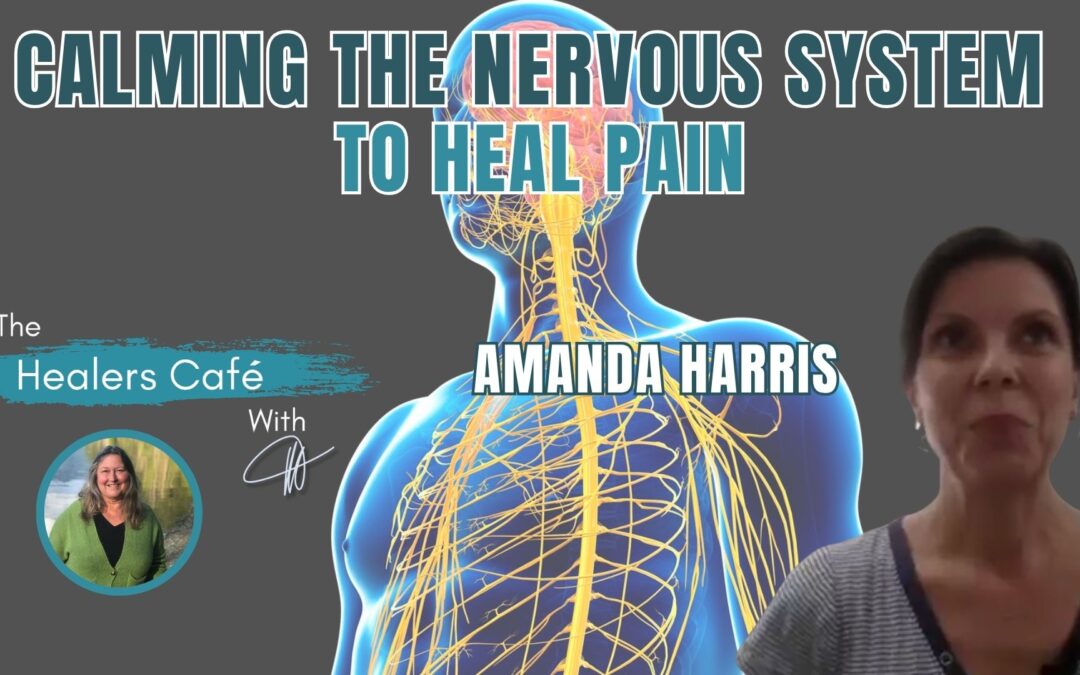
In this episode of The Healers Café, Manon Bolliger, FCAH, RBHT (facilitator and retired naturopath with 30+ years of practice) speaks to Amanda, a movement specialist, discusses her unique approach to pain management, focusing on correcting faulty movement patterns and calming the nervous system.
Highlights from today’s episode include:
Amanda says chronic pain is often a nervous-system problem; calming fight-or-flight is key before new movement can heal pain.
This is the 2nd podcast – to listen to the 1st podcast go to: https://www.drmanonbolliger.com/amanda-harris/
Amanda describes a hybrid model (online course + weekly Zoom + Voxer + optional 1:1s) can be more supportive than in-person only.
– – – – –
Manon explains if you keep repeating the same explanations, turn them into an online resource, bonus, or membership to educate and support patients at scale.

ABOUT AMANDA HARRIS:
Amanda Harris is the owner and founder of Re-Kinect Medical Exercise in Richmond, Virginia. She specializes in working with people who have chronic low back pain for any number of reasons, including disc herniation, spinal stenosis and various spinal surgeries. In addition, she has extensive experience working with those who have undergone total knee, hip or shoulder replacement.
Amanda has over 25 years of experience in post-rehabilitative and medical exercise, and is passionate about helping people return to the activities they enjoy after injury or surgery. She has had the good fortune of collaborating with top physicians and physical therapists over the course of her career.
Her unique approach includes using carefully selected and graded exercises and movement patterns to teach the body how to move better and without pain. Breathwork, mindset training and education on what’s happening in your body reduces stress and brings about the positive environment needed to truly heal and move beyond pain.
Amanda’s credentials include:
Master’s Degree: Exercise Physiology from the University of Virginia
Certification: Medical Exercise Specialist from the Medical Exercise Training Institute
Certification: Redcord Active Specialist from Redcord International
Certification: Neurokinetic Therapy Level 1
Core purpose/passion: My core purpose and mission: to help people free themselves from bodily pain–not just for now, but in the future as well–so they can resume the active lifestyles they love.
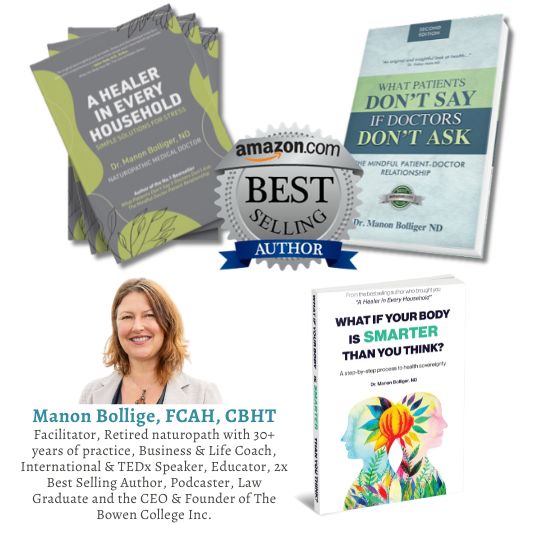
ABOUT MANON BOLLIGER, FCAH, RBHT
As a recently De-Registered board-certified naturopathic physician & in practice since 1992, I’ve seen an average of 150 patients per week and have helped people ranging from rural farmers in Nova Scotia to stressed out CEOs in Toronto to tri-athletes here in Vancouver.
My resolve to educate, empower and engage people to take charge of their own health is evident in my best-selling books: ‘What Patients Don’t Say if Doctors Don’t Ask: The Mindful Patient-Doctor Relationship’ and ‘A Healer in Every Household: Simple Solutions for Stress’. I also teach BowenFirst™ Therapy through Bowen College and hold transformational workshops to achieve these goals.
So, when I share with you that LISTENING to Your body is a game changer in the healing process, I am speaking from expertise and direct experience”.
Mission: A Healer in Every Household!
For more great information to go to her weekly blog: http://bowencollege.com/blog.
For tips on health & healing go to: https://www.drmanonbolliger.com/tips
SOCIAL MEDIA:
– Linktr.ee | Rumble | Gettr | Facebook | Instagram | LinkedIn | YouTube | Twitter |
About The Healers Café:
Manon’s show is the #1 show for medical practitioners and holistic healers to have heart to heart conversations about their day to day lives.
Subscribe and review on your favourite platform:
iTunes | Google Play | Spotify | Libsyn | iHeartRadio | Gaana | The Healers Cafe | Radio.com | Medioq | Audacy |
Follow The Healers Café on FB: https://www.facebook.com/thehealerscafe
Remember to subscribe if you like our videos. Click the bell if you want to be one of the first people notified of a new release.
* De-Registered, revoked & retired naturopathic physician after 30 years of practice in healthcare. Now resourceful & resolved to share with you all the tools to take care of your health & vitality!
TRANSCRIPT
Introduction 00:00
Welcome to the Healers Café. The number one show for medical practitioners and holistic healers, to have heart to heart conversations about their day to day lives, while sharing their expertise for improving your health and wellness.
Manon Bolliger 00:17
So welcome to the Healers Cafe. And today I have Amanda Harris for the second time, and we’re going to do a sort of follow up and open up a little bit the discussion to her online program. And I think one of the angles that, at least I’ve been asked this so many times, and Amanda correct me if I’m wrong. But patients have, or, you know, clients have a lot of questions, you know, how do I get what I need from myself? How is it different? How would I benefit potentially more. What’s the group dynamic? I mean, we can go lots of places, but oh yeah, before we go there, I’ll remind people a little bit your bio and what you do specifically so you’ve been mentored by and actively collaborated with some of the top surgeons, neurologists, manual medicine physicians and physical therapists in the mid Atlantic area over the last 25 years, and that has all given you a unique perspective on how the body should move and how that movement itself can help heal. And so part of your work is identifying faulty movement patterns and using gentle movement and exercise to correct them, and and so getting rid of back pain, and often many associated other types of pain. So yeah, welcome back and maybe share a little bit about that, not why and how you got there, because we got that from last time. Yes, but tell, tell the audience who might be new to you a little bit what your work entails.
Amanda Harris 02:13
Exactly. Sure. Well, thank you for having me again. Manon, first of all, I really appreciate being back on the healers cafe, so a lot of what I do is I feel like I’m kind of one of that great one of those great last hopes I think you’re one of those two where people find me when they’ve exhausted all the mainstream options, and so often, by the Time folks get to me, they are hurting quite badly, and they don’t have a lot of answers. And so the people that that find their way to me often start with back pain, but by the time I see them, they often have other complaints like hip pain or knee pain or sometimes even shoulder pain, and they start to get this feeling that they’re falling apart. It’s, really, it’s kind of sad to see somebody in that state. You know that they come to you and they’re, they’re almost desperate for help, and they’re looking at you like, I don’t know about you, you’re not a doctor, but the doctors haven’t had a lot of answers for me at this point. And so I’ll try just about anything, like, tell me what to do, and I’ll do it. And so, you know, we start with an assessment, and nothing that I do is not scientifically based. My mother would hate that double negative, by the way. But you know, everything I do is based in science. And although often when we get to the end result, clients tell me it seems like magic, it’s not magic. It’s all based on science, and most of it is based on neurology. Ironically, even though I’m not a neurologist, I’ve learned a lot about the nervous system over the years, and so my method really is helping the client understand what their body’s trying to tell them with those painful movement patterns, and then teaching the body how to move without pain again, which often involves helping to calm the nervous system down. And I don’t mean that we’re just, you know, meditating and doing things like that, although that can help. But often, you know, stress impacts the results of this work, and people don’t even realize how much the pain they’ve been in, escalates their stress. And then if they’ve got job stress or relational stress, or any other kind of stress on top of that, it’s like their system is in fight or flight hyper overdrive all the time. And so one of the first things we talk about is how to try to bring that down, and kind of bring the alarm system back down to, you know, out of that red alert zone and into a yellow alert zone so that we can actually operate. Because I think, like I said, by the time they get to me, when, when there’s so much discomfort and so much frustration, and often, you know, there’s a lot of discouragement, and we just gotta bring that. Down to where the body is in, a place that it can learn something new and start to work well again. So it’s, it’s an unusual way to approach pain, I think, because I think a lot of folks just jump right in and start giving exercises. And although, yeah, in the first session, you do get some exercises, we also have to have a little talk about this, because once you understand it, it’s easier to start on the journey. You know, if you’re if you’re still fighting, you can’t go down the road. So anyway, that’s, that’s part of my unique approach. It’s, it’s definitely a unique starting point. But clients tell me that it’s immensely helpful to understand what’s happening in their body and why they’re so jacked
Manon Bolliger 05:42
up, right? Yeah, I mean it. You know, what I had forgotten is that there’s a lot of similarities with with Bowen, because we also work with the nervous system. And you know, if you’ve been, for example, in a car accident and you have whiplash, you’ve got to deal with the the trauma on the the impact that that has on your nervous system, before we start tweaking little muscles right, like, you know, and then people get it, it’s like, Oh, of course, that’s why I can’t seem to heal If I go to my let’s, you know, XYZ, yes, you know, I think, yeah, that part has not been, hasn’t taken its place in history well enough, but I think we’re trying hard, right?
Amanda Harris 06:32
Yes, we’re trying hard. We are, and hopefully we’re making a big impact with everybody walk through our doors, you know, yes, exactly now.
Manon Bolliger 06:41
So this course, because not everyone has the courage to put things online. What What motivated you to do that? How’s it different for you? How does it work? Let’s talk about that. Sure.
Amanda Harris 06:57
Well, I’m afraid what motivated me originally is not very exciting, because so many people have a story like this. It basically happened during covid When the government shut us down and I couldn’t see clients. And, you know, when you’re in ..
Read more...
that situation and you’re a small business owner, which I am, you know, the first thing that hits you is, oh my gosh, how am I going to eat? And and so, you know, we my husband, who’s also a small business owner, but but had an online business at the time, we immediately went into problem solving mode about it. And one of the first things he said to me was, Can you do any of this online? And honestly, Manon, a lot like you. I was so used to having my hands on people and having them in front of me, I could not imagine how I could do this work online. And it probably took me at least four weeks, you know, I joke that I ran around with my hands on my head, you know, going, what do I do, what do I do, what do I do for about four weeks, how I was going to survive that shutdown. And then somewhere along the way, I thought, I’ve got to be able to do something online. And so a lot of like what I described to you about the nervous system, I sort of delved back into the books that I had where I had done some some learning, either distance learning, or, you know, maybe some textbook learning, or even one of the methods that I use called red cord. I kind of dove back into some of the pedagogy from red cord, and I looked at like, what are, what are we actually doing here with these exercises? Like, you know, this is different, for a reason. Is there any way that I can talk people through similar exercises, even though I can’t put them on my equipment, and so I sort of just went into big time problem solving mode. I started tweaking a lot of the home exercises that I gave clients. I started creating real micro progressions, like little, teeny, tiny progressions of my exercises to see if I could get a similar result that I was getting in the office and and then I started calling people. And I just called some of my, my most dear, regular, longtime clients, and said, Hey, will you experiment with me? And all I ask is that, if you like it, will you do some sessions with me online, and if you don’t like it, tell me why you don’t like it, like, why it’s not working for you. And you know, I think I wound up doing close to 15 to 20 sessions a week once I started offering them, and people actually really liked them, so much so that I’ve had a couple that have stayed online, even though they are within driving distance to my office, they have chosen to see me online, like ongoing, because it’s more convenient. They don’t have to drive it and so, so I realized there was something there, and then from there, I just thought, you know, like, Are there similarities enough in how I start people off that I could create a. Course, that has a menu of different exercises at every level, but so it allows for some customization. But that, you know, we hit all the similar notes, we hit all the right movement patterns. It’s just that, you know, customer, a client, a might be doing you know, numbers one, two and three of a level one, you know, option. And if I have six exercises in there, you know, I might have a second customer or client that’s doing, you know, numbers two, four and five, or something like that. And so I can it offered a way. I created a way for us to kind of semi customize the experience, right? And then I also, I tried. At first I thought, you know, maybe this was okay as just a self paced course. And then I found out, as a lot of people did, that self paced courses don’t work for people like us, because the students with all the best intentions start it, and then they don’t keep going, because they just don’t have the motivation. And so that’s when I added the weekly zoom sessions. And the weekly zoom sessions have turned out to be so valuable because there’s a community there, there’s a support system there, yeah, that. I think a lot of my my one on one people, my in person people, kind of envy, you know, because you feel really alone when you’re hurting, especially if you’re the only one in your family with back pain, it can feel very lonely. You can feel like, is this just me? Like, why is my body falling apart? Why? Why is this my experience, and nobody else is like me, and then suddenly you’re dropped into this community of other people going, you know what that used to happen to me too, but I got through it doing these exercises, and you will too. Or, you know, I had a setback last week, but this is what I did, and it really helped me. And you start seeing those connections, and you start seeing the hope blossom. See friendships getting made. It is very cool. And then I realized, I was like, Oh, this is really good, and I really enjoyed it. And then Manon, the latest iteration that I’ve added, because I wanted to create an even more customized experience. I wanted to create a higher touch experience. So I added using this free app that you can get through the App Store on called Voxer, P, O, X, E, R, it’s, it’s free, and I so I’m not getting paid anything to tell you about it, but it’s a walkie talkie app, and it’s so cool because you can, you can talk, you can text, you can like, you can talk into it, and it’ll record, and then it’ll ping me that somebody’s left me a message, and I can listen to it between in person clients. I can listen to it on my ride home. I could so I can answer faster than if somebody calls me and leaves me a voicemail or emails me, or even sends me a text message. Because I don’t know about you, but my text messages are full, but I look at that Voxer app probably 20 times a day, because I know those are my online people, and I am constantly in communication with them, so they feel like they’ve got a lifeline, and I’ve got a way to touch them and keep them motivated and keep them coming in so neat. And it also allows me to kind of direct their experience. So if they get through a series of exercises and they have questions or they want to know what’s next, I can tell them I it’s been amazing how I can take what I love about my in person and make it work online. It’s It’s amazing.
Manon Bolliger 13:37
Yeah, very interesting. Yeah, yeah. I had also a little bit of a positive experience, despite, you know, a lot of resistance, you know, it’s like, Yeah, can’t teach, you know, hands on therapy, because it was actually to teach the therapy. Yeah, right, not to do it, but to teach and, and I resisted that, like, oh, there’s no way. There’s no way. And, you know, I was wrong.
Amanda Harris 14:05
So you, you teach it online too now, well,
Manon Bolliger 14:08
not, not at all, exclusively. It’s an awesome and of the times they they need to do certain hours, it’s, it’s allowed, you know, one time. But it makes a huge difference because their perspective in being part of a group and listening online in the comfort of their home, yes, different. So I’ve had a lot of very positive feedback on it, which is interesting. You know, it’s like sometimes you just have to move things around a little bit and see what happens, right? And you know, if it what, like, I didn’t go exclusively on because in the end, like, how could I, you know, certify somebody or recommend them, yeah, their work, yeah. Or even felt it on my body or one of my instructors. Years, right? Like there’s there’s limits, you know. But I found it also, as the observer, you’re in a slightly different mode when you’re watching through the screen. Yes, you know, you pick up different things than you might pick up in person. That’s true, you know. So I found it. It worked quite well, you know. So, yeah, very interesting.
Amanda Harris 15:25
It is really interesting. And I have really loved the feedback, you know, and it’s evolved over time, and I would argue it’s still evolving, you know, I get feedback from everybody that’s in the program. I’m asking them constantly, like, always, feel free to give me feedback on a process or a thing that I’ve asked you to do, or, you know, a video, like, if there’s a video in the course that they feel like needs to go deeper, I’m always open to that. And what I have loved is, every once in a while, I’ll get somebody that is interested in getting into the course, especially because of the convenience factor, you know, it’s, it’s a lot to, you know, have all the, all the things that we have to do on our plates, and then you got to drive somewhere for some kind of a therapeutic modality or something, right? Like, that’s one more point month, one more trip out and back, etc. And so, you know, part of what has been really appreciated is that they can practice, you know, wherever they are, whenever they are, and get their get their work done. But the one of the big questions is always well, how do I know I’m doing my exercises right?
Commercial Break 16:33
What would your life be like if you were pain free? If you were one of the millions who suffer from chronic pain, the thought of just one day without it may seem impossible. This is often because conventional medicine tends to fall short in the treatment of pain, opting to prescribe pills or recommend surgery rather than getting to the root cause of the problem. But if you are suffering with emotional or physical pain, there is hope. Join the founder and CEO of Bowen College, Manon Bolliger, live online for Your Body Mind Reboot. Learn how to listen to your symptoms and get to the root cause of your pain, plus be trained in basic Bowen therapy moves so that you can reboot your body for optimal health. You don’t have to live in pain. You can heal, stop the pain pill cycle by visiting www dot your body mind reboot.com to learn more and to register
Manon Bolliger 17:42
right. Right, right? Yeah.
Amanda Harris 17:44
And so we address that often in the weekly sessions, especially if somebody has a question about what they’re feeling in an exercise, or what what the exercise is supposed to be teaching them. And so we’ll do a deeper dive into the exercise. But then I’ve also learned to just say, well, let’s see if we can schedule a one on one session. So if they’re out of state or something, then we’ll do it via zoom, but if they’re local, then they can come in for that one on one session. And it might be a one off, or it might be a once a month. But what I’ve learned is that people need to experience this work differently, and not everybody’s cut out for the online piece, but there are a lot of people that are cut out for a hybrid version, which is fairly neat. And I think for the longest time, I was thinking it was either or. But to your point, it’s kind of nice to bring the two ends together, and can be very effective that way. And I am getting to the point where I actually really like it more than just the straight one on ones, because I think the the access to those videos where I’m teaching the exercises, and you can watch me teach that exercise again and again and again. You can keep rewinding it, whereas, if you’re an in person client, it’s, you know, you got me for the hour, and then you get home and you can read the instructions, because I send him instructions, but it’s like, uh, I don’t know if I remember this right, right? I feel like in a lot of ways, my online folks have an advantage,
Manon Bolliger 19:09
yeah, well, I mean, it also lends itself to, like, a membership type of way of doing things, where you could have your live clients come in, yeah, but you could sort of lead them in with sort of necessary education, you know, where you would have, like, a month of free. I mean, I’m just throwing ideas out, but yeah, you know, I love the ideas they you know, they get educated. They know how it works, what to expect. And then they, they continue at whatever rate. I, you know, it has to be something reasonable for people to, you know, to value, but also that they, they’re going to stick to it. And then all the exercises are there. The repetition is there. Because it’s such a great feeling. You know, I know in homeopathy, it’s not physical at all, but, you know, I used to teach classes just on acute, you know, for like a Titus media or, you know, basic stuff that you can do for your family. You know, patients would love coming in and saying, Well, I tried this because it looked like that, you know, the basic stuff, you know, and it’s like, and it worked, you know, or it didn’t work, whatever, you know, because homeopathy is very complicated. You don’t, you know, you don’t always get it, but our ways of getting it and just that the knowledge that could be shared where they could, you know, go through this and feel competent in it. Yes, it’s really exciting. You know, when you’re saying, Is this how you do the exercise again, like, you know, you know, they’re participating actively in their improvement, right?
Amanda Harris 21:02
Yes, yeah. And it’s like I said, it’s just so much fun for me to have those group sessions weekly and watch the growth and watch the ahas. I mean, that’s one of my favorite things about what I do, is that that moment where the person goes, Oh, and you see that, right? You see that epiphany. And, man, that’s like an elixir to me. You know, when I see him get it and it’s like, Oh, I understand this. This is what this is supposed to feel like. This is amazing. It’s like, yes, yes.
Manon Bolliger 21:34
And the other thing is, for referrals, you know, so often people would say to me, Oh, what do I tell them? You do? You know? Because, oh yes, you know. It’s like, Oh, my God, you know, like it works. But what do I say, you know,
Amanda Harris 21:50
I don’t know how to describe what you do. I get that so many times, like, I have clients that will say, you know, I was trying to tell my friend about you because she really needs your help, but I did not know how to tell them about what you do. Yeah, it’s very difficult. Yeah.
Manon Bolliger 22:06
And therefore, if you have this kind of membership thing, or it’s an introduction, and they actually find out, see it, start being part of a community that you know goes on or doesn’t, you know, it’s their choice, but it’s, it’s a great way to, you know, to I’m always a creator. So I,
Amanda Harris 22:26
oh, I love this idea. Yeah, this is, you got my wheels turning now. Got me really thinking about this. It’s great.
Manon Bolliger 22:35
Anyway, I always see the the the potential in what is, and then you know how to spread it and and, you know, and to enjoy what we do, right? Like, yes, you know, it’s, it’s fun. It change, little changes, and all that makes such a difference. You know, it’s exciting, right? It’s like, and then you find another, it’s almost like a slightly different language.
Amanda Harris 22:58
And, absolutely, yeah. It is fun. I mean, like, I said, the most fun thing for me is just watching the light go into their eyes when they and you’re just like, Oh, that’s it. That’s what I was looking for. Yes, definitely, yeah.
Manon Bolliger 23:15
So do you have like, the most common questions, you know, like, like, FAQs, you know that people ask, like,
Amanda Harris 23:22
frequently asked questions, yeah, about, about my method, about the course, like, what are we either,
Manon Bolliger 23:29
or actually, you know, could be about the method so that, let’s say the brand new people that are that your clients want to refer and
Amanda Harris 23:42
it questions that I get asked with some regularity because, because one thing I have learned is that it’s a lot easier to have a client that is already bought and sold on exercise. You know, if somebody is averse to exercise, and I’ve had those clients before, and, boy, that is really hard. You know, that’s pushing the rock up the hill because they don’t like to move. They don’t want to move, and they sort of feel forced into something that they you know, they’re trying to do this to deal with the pain, but they don’t really want to be there. That’s a very different animal than the person who really believes exercise has a solution for them, they just haven’t found it yet. And that’s how I was with it. That’s how that’s where my method was born out of was my desire to get exercise to do the job, instead of injections and pills and surgeries, you know? And so I would say, one of the biggest questions I get, because I serve an audience that’s already loving exercise is, do I have to quit working out? Do I have to quit training? Because many of my clients come to me because they’re tired of having pain after their workouts or after their training, or sometimes at the end of their training, you know, they’ll get back pain. When they’re doing something physical, and it frustrates them, because their identity has always been wrapped up in being an athlete or being very physical, and now that physicality is causing pain and they’re not they’re scared. I’m going to tell them to quit working out. And I’ll be honest, there are people that, after a while I just say, Okay, we need to cool it for two weeks and see if we can get you through the storm, and then let’s tiptoe back into it again. But a lot of people, I will tell, yeah, you can continue to work out as long as your workouts aren’t causing pain, right? So if there are things that we have to omit temporarily so that we can get to the other side and then you can start resuming them again, great. But what I really try very hard never to tell somebody, no, you can’t work out while you’re doing the first six weeks of this work, because I think that’s very it’s very hard on their mental and emotional state, you know, because they often use that as their stress control, and, you know, their identity and all of that. And so I try very hard to say, yes, you can keep exercising, just make sure that you’re choosing things that don’t cause you pain afterwards. And you know, that ensues a big conversation, but that’s probably one of the biggest ones. And so because I very much believe in exercise, I very much believe in movement, I also know that when the body is hurting, we often have to lower the challenge to the system, you know, and that often means backing off on intensity of exercise or load, you know, like, how much are we How much are we putting on this body and causing the pain? Yeah, and so often, it’s a bit of a gray area, but that’s, that’s probably one of the frequently asked questions, and my answer is always, well, it depends which is so unsatisfying, but it really is a case by case business, and I do my very best to not have to say, No, you can’t do anything but these exercises, because I don’t really believe that’s right.
Manon Bolliger 27:03
Yeah, no, no, and it’s better to teach them to become more connected and intuitive to what their bodies can handle and can’t, you know, then follow some sort of you know, authority that says this and that, you know, because those days are gone.
Amanda Harris 27:22
Oh yeah, yeah. And, I mean, let’s face it, i The whole reason we’re doing this is so they can enjoy whatever they were doing without the pain. It’s just that temporarily we might have to peel back how much or how hard they’re going so that it’s not creating the pain. Because we’ve got to get them out of that, that that stress cycle of pain and fight or flight and all that stuff.
Manon Bolliger 27:43
Yeah, my biggest one, yeah, what do you think is, or what? What is the most common cause of back pain that you see?
Amanda Harris 27:59
Well, that’s a really good question. I gotta think about that a little bit. You know, I think it’s often, well, I’ll go two ways. I think, I think there are two. There are two different ones. I think one of them is sitting postures and too much sitting, you know, there’s, there’s like a combo there. Most of us, modern humans sit too much. Anyway, too much, whatever too much is. Because I think you know, if we if we didn’t sit in chairs, we would sit better. Don’t you think like if we didn’t sit in chairs? And I mean from the get go, I don’t mean now, because now our bodies are so used to chairs. But I think if we didn’t have chairs to sit in, you know, you think about like people in a third world country that are squatting to eat and sitting on the floor to eat and things like that, we would move more, because sit in a chair, you fidget and you squirm because it’s not very comfortable to stay there for very long. So, you know, I think, I think chair sitting, and then the expectation that we should be able to sit in a chair for so long, which starts in grade school, right? You know, sit in that chair and don’t get out of it until I tell you, right? So we get into these things where, I think we ask our bodies to sit and be still too long, and and then folks find a way to prop themselves that is quasi comfortable, and then over time, that creates too much pressure somewhere, and can cause a lot of back pain. So I feel like I see a lot of back pain from from bad sitting and then, and then I also see a lot of back pain from kind of ignored. What do I say, ignored, like aches and pains and injuries. You know, I tweaked my knee, but I’m going to pretend I didn’t, and I’m going to keep running, or I’m going to put a sleeve on it, and I’m going to keep running. Or, you know, I turned my ankle, but I don’t really need to go to PT for that, right? So I’m going to. Keep walking, or I’m going to keep running with a semi sprained ankle, or so I feel like, often, the chronic back pains come out of of sort of innocent ish injuries that were just never fully addressed and never fully, can I say, rehabilitated, like the joint was never taught how to move well again, and so it created an unevenness in the body that manifests maybe years later as back pain, because there’s been so much unevenness and and uneven movement, often with walking right so you know a stiff ankle or a stiff knee or a stiff hip that that you know You walk like that for years and years and years it’s going to show up in your back.
Manon Bolliger 30:45
Yeah, exactly, literally, like a crutch, yeah.
Amanda Harris 30:49
And I think, I think people, they have the injury, sometimes it’s even in middle school or high school, and they forget about it and they just, you know, move around it for years and years and years until it shows up in their back and it becomes a real problem. And often, you know, when I start asking questions in a history, and I especially if I notice movement is limited somewhere, and I’ll say, did you ever enter this part? And somebody will be like, Oh, well, playing basketball in eighth grade. Or, you know, water fell, fell water skiing when I was in high school. I hadn’t thought about that in years, right? And sometimes as a smoking gun, I think, yeah, for sure.
Manon Bolliger 31:31
I can’t believe it, our time’s already up. Oh my gosh. Part two and we’re done, yeah, wow. So how do people get in touch with if they’re interested, let’s say for an intro, or just take your course or work with you. What’s the best?
Amanda Harris 31:49
Well, you can email me directly at [email protected] which I’m guessing you’re going to put in the show notes, because I spelled reconnect kind of funny. Connect is like kinetic. And then you can also look me up on Instagram, that’s reconnect RVA. So if you’re on Instagram and you want to kind of take a look at what I’ve been posting and get a little idea about my content, you can look at me there. You can also go to my site, which is reconnect.com and you can learn a little bit more about my method and about who I am from there. You can also contact me through my website, so several different ways to reach out to me. I’m always happy to answer questions to meet new people. So yeah, I would love it. If anybody who’s curious about what I’m doing would like to reach out, I will absolutely email you back.
Manon Bolliger 32:37
Okay, well, thank you very much for your time, and it was lovely speaking to you again. It’s great speaking with you again. All right, so the highlight for the discussion with Amanda Harris would for me, is really aimed at practitioners. If you find yourself, you know, repeating the same thing, or you can see a commonality in your, you know, first few visits, or parts like the, you know, frequently asked questions. That’s a good comment to consider going online and giving that as a bonus or a membership, that’s what I’m looking for, a bonus or a membership, you know, or or a program you know, if you’re so that they can follow in case it is more convenient for them to do things online. And I really like her model, where you can do it online, but you can also come in and and get, you know, extra sessions that are very specific to you, so that you are able to adapt it to yourself more easily. And at the same time you know she she also shared how patients, then can listen to the videos over and over, and therefore get the exercises right, because I know when I did physio, and after I got home, I took little notes, and it’s like not getting it exactly, what am I supposed to do? And so if you have videos for all this, it’s really helpful for your your patients.
ENDING:
Thank you for joining us at the Healers Café. If you haven’t already done so, please like, comment and subscribe with notifications on as I post a new podcast every Wednesday with tons of useful information and tips for natural healing that you won’t want to miss.
Continue your healing journey by visiting TheHealersCafe.com and her website and discover how to listen to your body and reboot optimal health or DrManonBolliger.com/tips.