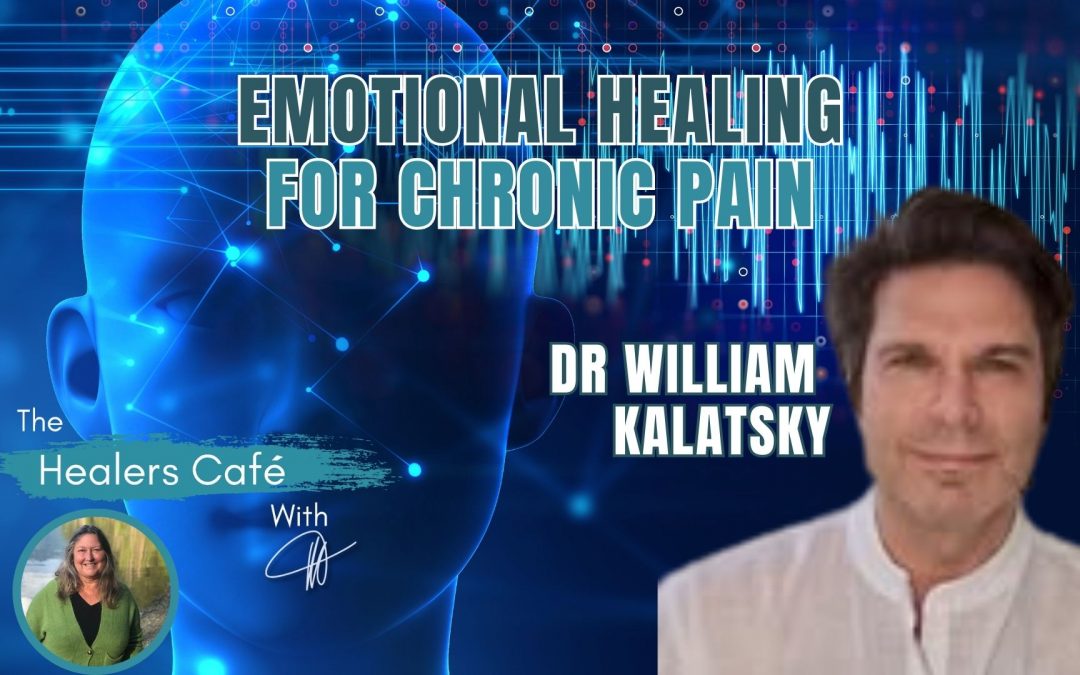
Emotional Healing for Chronic Pain with Dr William Kalatsky & Manon on The Healers Café
In this episode of The Healers Café, Manon Bolliger and Dr William Kalatsky continue their discussion on holistic healing, focusing on Manon’s partner Tony’s chronic pain and emotional stress. Tony has been suffering from neuralgia pain since a shingles outbreak two years ago, which has been exacerbated by family conflicts and societal pressures.
Highlights from today’s episode include:
Dr. William explains Emotions create measurable physical effects, so clearing emotions can ease physical pain.
Dr William describes how changing your inner “frequency” (beliefs and default emotions) gives you more freedom and choice.
– – – – –
Manon shares that William helped clear her mind and had a peaceful impact on her. Manon and William discuss the importance of gratitude and how it can positively impact one’s life.

ABOUT DR WILLIAM KALATSKY:
Dr. William Kalatsky is a pioneer in the field of consciousness and emotional healing. With decades of experience in chiropractic care, meditation, and energy work, he developed Field of Consciousness Healing, a method that helps people release trauma, dissolve limiting patterns, and step into new levels of clarity and freedom.
At the heart of his work is a simple yet profound truth: emotions are frequencies stored in the body and field of consciousness. When unresolved, they continue to shape our thoughts, relationships, and health. Dr. William’s method guides people to identify these patterns, clear the frequency of trauma, and install new emotional codes of peace, gratitude, and empowerment.
He is the author of The Intuition Method, which offers practical tools to strengthen intuition, rewire subconscious patterns, and manifest aligned outcomes. His sessions and workshops have helped clients from all walks of life—professionals, entrepreneurs, and trauma survivors—experience rapid transformation. Many report that painful stories can be remembered without emotional charge after just one session.
Dr. William’s work bridges science and spirituality. Collaborations with institutions such as the University of Miami explore how brainwaves, HRV, and biometrics validate what thousands have experienced firsthand: when the field of consciousness is cleared, the mind and body reorganize into health, resilience, and creativity.
Whether speaking on stage, leading group healings, or working one-on-one, Dr. William brings clarity, compassion, and a deep commitment to human potential. His mission is to show that freedom from trauma is possible—not in years of struggle, but often in moments of breakthrough.
Core purpose/passion: My purpose is to help people free themselves from trauma by clearing the specific frequencies that keep old pain alive. This work is always evolving. Years ago, I was clearing the frequencies of migraine headaches in hospitals in England. That led me to discover that unresolved emotions were behind the pain. Each realization has taken me deeper, and I don’t know where the next evolution will lead. What I do know is that when people release trauma and move into peace, joy, or love, it shifts not only their life but the frequency of the entire planet.
ABOUT MANON BOLLIGER, FCAH, RBHT
As a recently De-Registered board-certified naturopathic physician & in practice since 1992, I’ve seen an average of 150 patients per week and have helped people ranging from rural farmers in Nova Scotia to stressed out CEOs in Toronto to tri-athletes here in Vancouver.
My resolve to educate, empower and engage people to take charge of their own health is evident in my best-selling books: ‘What Patients Don’t Say if Doctors Don’t Ask: The Mindful Patient-Doctor Relationship’ and ‘A Healer in Every Household: Simple Solutions for Stress’. I also teach BowenFirst™ Therapy through Bowen College and hold transformational workshops to achieve these goals.
So, when I share with you that LISTENING to Your body is a game changer in the healing process, I am speaking from expertise and direct experience”.
Mission: A Healer in Every Household!
For more great information to go to her weekly blog: http://bowencollege.com/blog.
For tips on health & healing go to: https://www.drmanonbolliger.com/tips
SOCIAL MEDIA:
– Linktr.ee | Rumble | Gettr | Facebook | Instagram | LinkedIn | YouTube | Twitter |
About The Healers Café:
Manon’s show is the #1 show for medical practitioners and holistic healers to have heart to heart conversations about their day to day lives.
Subscribe and review on your favourite platform:
iTunes | Google Play | Spotify | Libsyn | iHeartRadio | Gaana | The Healers Cafe | Radio.com | Medioq | Audacy |
Follow The Healers Café on FB: https://www.facebook.com/thehealerscafe
Remember to subscribe if you like our videos. Click the bell if you want to be one of the first people notified of a new release.
* De-Registered, revoked & retired naturopathic physician after 30 years of practice in healthcare. Now resourceful & resolved to share with you all the tools to take care of your health & vitality!
TRANSCRIPT
Introduction 00:00
Welcome to the Healers Café. The number one show for medical practitioners and holistic healers, to have heart to heart conversations about their day to day lives, while sharing their expertise for improving your health and wellness.
Manon Bolliger 00:17
Welcome to the Healers Cafe, and today I have with me, William. Now, did I say this? Right? Kalatsky. Kalatsky, yes, perfect. Okay, and this is actually part two, because we had such an exciting part one, and William generously offered to see if he could clear some of the stuff in my mind. And it had such a stilling, peaceful impact. And I also talked about Tony, my partner, who’s suffering from enormous pain. So he said, Well, let’s try it, and let’s just do this. So we are going to be filming the types of questions. So Tony, if you have questions, please ask this is like a normal ish there’s nothing normal in my life, but normal ish interview, and we’ll see how, yeah, how this goes. I’m super excited and very grateful that you’re willing to share this excited to learn with you.
Dr William Kalatsky 01:22
Also, fantastic. Great. Well, let’s, let’s do it then. So Tony, why don’t you tell me what is happening for you and what you’re willing to share there?
Tony 01:39
I’m not sure whether they said it began nearly two years ago, in December I had shingles, and that Manon helped me help that disappear with homeopathy. And that went very quickly, but after that, I started having this neuralgia pain, and basically it’s all down my right hand side, and it goes down into my neck and my shoulders. And it’s, it’s pretty consistent, and it’s, yes, it’s really painful, okay?
Dr William Kalatsky 02:12
And what about the emotional side of it? Because Manon mentioned that you had, you were overwhelmed on some level, maybe due to the physical pain, maybe it created more emotional stress.
Manon 02:26
Well, it was things, no, it was New Year’s Eve dinner, where things kind of happened. And there I was mentioning, there, you know, he felt very suppressed, not unable to talk because we had, you know, we have a very close family, but we, we don’t all agree on what’s happening in the world.
Dr William Kalatsky 02:50
Yeah, sure,
Manon Bolliger 02:52
and not that one has to agree. But when it concerns health,
Dr William Kalatsky 02:57
yes, it’s important.
Manon Bolliger 03:00
Yeah, it’s important, and it’s a pet peeve of mine. And of course, Tony, one of his children, is a nurse, and, yeah
Dr William Kalatsky 03:11
yeah, so it’s a good debate, or no debate,
Tony 03:14
or no debate.
Manon 03:16
I think that’s what you know. There’s a lot of anger. I don’t want to ..
Read more...
speak for you, but I know when he’s in pain like this, very hard for him to speak. So I’m
Tony 03:26
brilliant, yeah, that’s pretty close, yeah. I mean, during that whole period when Manon lost a license, and we really delved into what was happening, and it was very clear, you know, the information was there, how this whole pandemic began, and what was in place before it even began, with the injections. And, you know, like, so clear, but it was like, boom, yeah, you don’t talk about it. You’re a conspiracy theorist. And, yeah, I find that hard to be. And then, particularly around family and stuff being shut down and being called a democracy, there is just as you know, that’s bad, you know,
Manon Bolliger 04:08
and for for the health and the grandkids and you know, are they, you know? Because in British Columbia, you can do this to to young infants, and we still don’t know if it was done or not done, right, right? So we don’t know got it what we’re dealing with, right? Yeah, yeah.
Tony 04:31
And also, I think one big part was also with the family, the fact that Manon lost a license due to her ethics. And so many people have said, Oh my God, you know, like, how wonderful of you. And there’s been like, Nils with the family. It’s almost like, whatever. That’s mum. She’s just, she’s doing her thing. But it’s a huge thing to lose your life after 30 years. And yeah, of course. And then just not been. Able to talk about it really,
Dr William Kalatsky 05:01
right, right, right. Okay, got it so. So then, would you say, Tony, that for you, let’s call it like this internalized anger, that’s that’s pretty present
Tony 05:13
I’d say this a fair amount.
Dr William Kalatsky 05:16
Okay, okay, good. And would you say that’s the strongest emotion? Because what I do is I work with the field into the emotions, which then can affect the body. If what’s happening, look everything, any emotional stress we have is going to create a physical response, no matter what right you know, whether it’s a blood pressure goes up, whether the heart rate changes, we breathe differently, and then even more symptoms than that, sometimes. So if you’re having, you know, an emotional situation, it can affect physical and when we take the edge off the emotions, it’s kind of like somebody who’s over sensitive emotionally, everything bothers them, right? And you touch them and they overreact. So what we’re going to do is clear the emotional field, and then I’ll expect that on some level, your physical symptoms may be better because there’s a relationship there. So let’s start with this. So just notice how you feel now, and why don’t you tell me from one
Tony 06:13
aspect to it, I think it’s not just the anguish. It’s being misunderstood, you know, like being, yeah, like, really misunderstood, and not being listened to, I think, you know, or right, yeah, not being able to express myself. I think that’s certainly a part of it, yeah,
Manon Bolliger 06:32
well, misunderstood in that what you want is people’s good, you know, it’s like, we’re not trying to do a political act here. We’re trying to read about, yeah, so you don’t make a life altering
Tony 06:46
decision exactly, just, it’s not, oh, I want you to get my opinion. It’s not like that. It’s like, hey, you know this information is worth listening to, or, yeah, at least to make a choice.
Dr William Kalatsky 06:59
Yeah? Fascinating, right? Yeah. Well, it is. I mean, just I was talking to somebody in the entertainment industry yesterday, and they were talking about commercials and things, you know, they’re made to make you buy or believe that you should have it and, and I said, Well, every show on television is that, you know, James Bond wears a specific watch. So we want to buy that watch. Yeah, you know, it’s and so, you know, the media is, is a delivery system. Basically, it’s, it’s fascinating that, if we’re caught up on, you know, when I wrote my book intuition method, it was because back in around 2018 I had patients in New York, and I would watch them debating politics, and half, you know, would say one thing, half would say the other. And these are all holistic minded people. And it got to the point where I just realized it just depended which TV channel they watched. They watched they watched one, they felt this way. If they watched another, they felt this way, and they would have these conversations. And so I developed this method of accessing inner knowing so they could then either say, Okay, I know this method works. Now let me ask myself these questions and find out. Wait, either I’ve been lied to or this method doesn’t work like so it was really depending on what they wanted to allow themselves to believe at that point, so I completely understand what you’re talking about. So let’s get into it. Then let’s, let’s clear some of this for you. So what we’re going to have you do is, first, just close your eyes, and what I’m going to do first something I call clearing the field. It’s very simple. I’m just going to connect to your the field and the mind and just start to clear it, and it’ll take about 30 seconds. Just let your mind wander for a minute. You can think about maybe what you had for breakfast. You notice that think about the situation with the family again, notice how the thoughts are running a little differently, like they’re not just like a train coming in. Got that?
Tony 09:11
Yeah.
Dr William Kalatsky 09:13
Okay, good. So now I’m going to ask you one to 10, right? It might be a little lower now than it would have been a moment ago, but one to 10 tell me about the anger, the not being understood, that where would you put that from one to 10? If 10 was the worst,
Tony 09:27
maybe at five,
Dr William Kalatsky 09:32
five. Okay, would it have been higher a minute ago before?
Tony 09:35
I think so. Yeah,
Dr William Kalatsky 09:36
because I feel like I forgot to ask you before we started. That’s yeah. Let’s put it at a five out of 10. Okay, good. So close your eyes again, and now I’m going to have you feel that emotion, that feeling of this anger, some resentment, some anger at manipulation in the world that doesn’t allow you to get through to family members. And then it may be. Even leaves you feeling locked out of of their minds. Really, you don’t have the ability to share information and just feel that for a moment. What that’s like, that frustration, what I’m doing is I’m just distracting your mind from the topic we’re working on, because I want your mind to be in a place where it’s not holding on to a pattern of the feelings that we’re clearing because it makes it harder for me to clear it. If, if you’re holding it and feeling it while I do this, there we go. Only tune into the feeling of the anger, the frustration, feeling misunderstood again, and tell me how that feels for you now.
Tony 10:43
Yeah, I gotta reiterate. I’m not going around like angry all day thinking about this. It’s just that it’s a kind of background thing. It’s really only when I bring it up, when I think about it, so yeah, but yeah, for me, it’s like, with what you’ve just done or experiencing at the moment, it’s a little bit like, there’s more choice, you know, it’s
Dr William Kalatsky 11:07
right, yeah? And you’ll notice that it’s a little bit harder to feel it when you tune into it now versus a minute ago. It’s like, you know, it’s there, but the actual edge of those emotions are not as present, right?
Tony 11:23
Yeah, they use in Canada. I don’t really like it, like teenagers, yeah, on nerves, but it’s called whatever, whatever I got it.
Dr William Kalatsky 11:35
Okay, okay, so let’s, let’s say this. Now we had a, we’re at a five out of 10. So where would you say it is now, because we’re going to do another round of that, and so let’s just get another baseline.
Tony 11:48
Sure. I’d give it a four,
Dr William Kalatsky 11:49
a four. Okay, good. Let’s do it again. So let’s have you close your eyes again, and just if you can make those feelings stronger, go back to the last time you all had dinner together, the frustration involved, the anger involved the not feeling understood or heard, and really try to make it real for yourself, because the more you can bring up the feeling, the more we can clear it.
Tony 12:16
I’m still kind of in pain, but I got like when I say about choice. I mean, I’m the one with choice. Really, it’s, it’s how I react. You know, it’s not about it’s not in there. I’m not waiting for them in their ball court. So I got, like, a scenario, say, I’m at dinner, and we’re talking of with somebody, and it’s like, they’re like, No, I don’t want to talk about it. Normally be like, well, I can swear on this. It’s like, well, fuck you. You deal with your shit, you know, and but now it’s, it feels like, yeah, you deal with your stuff, you know. It’s like, it doesn’t really affect me. You know, their choices don’t really affect me. But I think what I’ve been doing is, you know, I’ve been angry and, like, sorted out. Have a look at this. This is clear, you
Manon Bolliger 13:06
know, well, especially family, right?
Tony 13:06
Yeah, especially family, yeah, and yeah. And then it’s like, okay, yeah, that’s your choice. That’s your stuff. It’s not my it’s not my business to be upset about your choices.
Dr William Kalatsky 13:23
Yeah, yeah. It is amazing how they really found a way to create a wedge in between families or friends where there never would have been one
Tony 13:33
that was part of the agenda. It really was psychologically, I think they, I mean,
Dr William Kalatsky 13:37
that’s why the media is so good. They’re so good at what they do. I mean, it’s brilliant,
Manon Bolliger 13:43
yeah, total propaganda machine.
Dr William Kalatsky 13:45
It is. I mean, the idea of, like, let’s, you know, on many levels, it’s not just about, you know, wellness in terms of illness and things like that, but it’s also social wellness in terms of, you know, the family structures being damaged because of belief systems that would have never been damaged many of the times, you know, it’s just, it’s really something. It’s really very, very, very well thought out.
Speaker 1 14:15
Well, I don’t know if you know this, but I was shocked to find out that it was one of the big Ivy Leagues. I think Yale did a profile of 16 different types of ways of doing their advertisements that thing, and they based in different countries, different ones based on the profile of the people. So, you know, Canada being, I’m sorry, you know, okay, children, family, and you don’t want to get your grandmother sick or somebody, yeah, right. Like, so when that came up, it’s like, I am sorry. This grandmother doesn’t. Have two hoots about that.
Dr William Kalatsky 15:02
New York was like that too, but Right, yeah, there’s a lot of that in New York. It was really something. And yeah, I mean this, so I have a lot to say about it,
Speaker 1 15:16
but it’s yeah, no, I think we’re general only those who know know.
Dr William Kalatsky 15:25
Yeah, okay, so let’s go back to Tony for one Tony before, before we get into the the physical again. Tell me about if you can think about that situation with the family, and the anger, the feeling unheard, and tell me how that feels for you.
Tony 15:40
Yeah, I think a little bit like I said that there’s a lot more choice in it, you know. And I can be there in the present and say, you know, do you want to go that way, or do you not? And it’s really seeing it correct.
Dr William Kalatsky 15:54
So, so this works as it clears the emotions, it puts you into the state of observer, and you’re able to literally little bit off of your it’s not the because you’re not the way this the way the frequencies for trauma and emotional pain works, and even for good feelings, except with good feelings, it’s a different mechanism. Is when something stressful or traumatic happens, we are affected as a vibration of frequency. So Tony, if I was to shake you by the shoulders all day long, for 24 hours, 48 hours, for a whole year. After a while, it’s going to affect your mood. You’re going to say, Why is everything always shaking and unstable and and you know, you’re going to be a different person after a while, until somebody says, you know, William’s been shaking you for two years. And then somebody moves my hand away. And this, you can imagine, is actually a vibration, right? I’m vibrating, you, they’d move me away. And then you have stillness again, and you’re and you’re saying, Wow, I thought it was me. And that’s, that’s the frequency that creates these negative emotions. We just don’t know it because it’s invisible. We don’t know it because, just like Wi Fi going through the air, you may not know it’s there, but maybe you’re suddenly getting a headache, right? And you just don’t have a clue that why you would have a headache, because it’s it’s not visible. And so everything is scaled up or down in terms of the emotions same way. So, so let’s go back and are there any other things right now that you can think of emotionally that affect you, bother you, something that’s on your mind? Because, if not, I’m going to ask you more about the physical, not really. Okay, good. So let’s do this. I want you to for a moment. I’m going to ask you to think about this physical condition that you have, the pain, how it affects you, maybe there’s other symptoms and how it makes you feel, to know that you have to deal with this, to know that it may never go away. And I’m not saying it’ll never go away, but I want you to just think about that so we could bring up that, so we could bring up that feeling. So how does that make you feel thinking that I’m stuck with this I’ve got to put in all this work.
Tony 17:51
Unpleasant comes to mind.
Dr William Kalatsky 17:54
Unpleasant sounds very, very non specific. So unpleasant. How about concerned? A little a little more like focused, concerned would be fair?
Tony 18:10
Yeah, actually, there is one thing I want to share that just happened yesterday, and it was so brief. It was like it was less than a minute. It it was like, 30 seconds, I was lying in bed, I was next Manon, and everything stopped. It was like, Oh, my God, I forgot what it’s like, you know, like, yeah, like, really, it was like, because this is with me constantly, you know, right? Yeah, it feels and it was, Oh, I remember, you know, wow, yeah, so it’s still there. So that was a moment of peace or stillness, or, yeah, just pure, like, normality, kind of, you know? And it’s like, I’m living with this, and I’m kind of almost getting used to it, you know, right?
Manon Bolliger 19:07
So if you had to, oh, go ahead, yeah, one of the things you verify that he often does is he says he thinks about what it must be like for me, right? So there’s, I don’t know whether that’s what emotion that is, if it’s guilt or
Tony 19:25
I’d rather call it compassion, but,
Dr William Kalatsky 19:31
well, it’s not exactly, I mean, it’s, on some level, there’s compassion there, but it’s, it’s really, yeah, it’s more along the lines of, you, if, if that’s the case, the guilt, my guilt, is not exactly the right word,
Speaker 1 19:48
like it has a it shouldn’t be happening feeling to it right, the feeling bad that is running with it. I do run quite well, but, yeah, the. Courses a lot, you know, but, but it’s funny, it’s often focused elsewhere than his own thing. He’s a compassionate person.
Dr William Kalatsky 20:11
Got it? Okay? So let’s do this, Tony. I’m gonna have you first, close your eyes again, and I want you to think about the idea that, gosh, what if this? What if I don’t win? What if this sticks with me, and this is my life, and so I want you to have that thought, because it should bring up a worry, and I know even if you don’t think that now, that’s underneath. So yeah, what if this doesn’t get better, I can’t manage it’s going to be really tough to manage life if this is every day, all the time. So just consider that. Think about that for a moment, how that would make you feel, and tell me how you feel when you’re thinking about the idea that this pain may be with you for the rest of your life. This way,
Tony 20:59
this is my mind going a little bit here. I feel like should be feeling depressed, but to be honest, I’ve never really experienced depression on much of a level, so I don’t really know what that means. Kind of trying to because deep down, I’m trying my best, but I don’t believe it. You know, I just believe this is something correct. It’s impermanent. I feel, and this is the same.
Dr William Kalatsky 21:28
Yes, so I’m from about a minute ago when I asked you to tune into that feeling. Were you able to feel it the negative? Like, gosh, what if I have to have this for a long time or every day? Yeah.
Tony 21:46
But yes, it’s almost like I’ve got to work at that, you know, yes, exactly, just again, right? So, you know, I’d be really honest here if I
Dr William Kalatsky 21:55
felt Yeah, no, no, of course. But the difference is, if you think about the effort put in to feel it, a few minutes ago, you were able to sort of grab onto it a little bit and recognize that feeling,
Tony 22:08
oh yeah.
Dr William Kalatsky 22:09
And now you can’t really easily feel that feeling. The mind goes to work as the observer and says, Oh, okay, and starts to see solutions and other viewpoints. So that once that feeling that locks us in is no longer present with us. No, right? It’s, it’s I, you know, I think I said to Manon the other day that if, if somebody’s ever been on a diving board, a high board, and you look down at the water and you’re frozen in fear because of a fear of heights, that fear literally freezes your body, and you can’t think or do anything else except be frozen in fear. And then if somebody comes along and either lets you down slowly or helps you down, suddenly the fear is gone, and you can be rational about it, but that vibration of fear literally restricts your whole life from moving. And as we clear this vibration of whatever the feeling was that you held before, worry, concern, suddenly the mind goes into this thoughtful place of, oh, okay, there’s solutions here and and how does the pain feel right now? I know it comes and goes, but
Tony 23:17
you know, it’s less. I mean, like I said, it’s, I never really, I get these really strong episodes, basically, nine or 10 like that. Yeah, it’s kind of round, a five or six, seven.
Dr William Kalatsky 23:37
That’s a five or six when it makes you seven. Yeah, wow. Okay, so 10 is high. Then, yeah,
Speaker 1 23:47
yeah, it goes from what was the thing is about between eight and 12 out of 10 in episodes, and it has a resting level of about six. Got it, okay? So he just lives with it. But there’s no ah and no sounds and no burping and no
Dr William Kalatsky 24:08
like, got it? Got it? Okay, so let’s, let me ask you again, when you tune into this feeling now you can say, okay, I don’t think it’s going to be the rest of my life. What is the worst part of this?
Tony 24:19
Mm, is the worst part of me thinking that or believing that, well,
Dr William Kalatsky 24:26
not believing that, but just the worst part of your life right now,
Tony 24:30
experiencing this, and it
Dr William Kalatsky 24:38
could be experiencing this, or it could be any part of your life, but what is the worst part of what’s happening in your life right now? Pain, the pain, okay, good, yeah, really, okay, and good, and this. So tell me again how this pain makes you feel in your life, how it restricts you in some way affects you.
Tony 24:59
Um, I mean, it should be obvious.
Dr William Kalatsky 25:11
No, well, I mean, it’s, I mean, I think I know the answer is that it redirects your life. You can’t enjoy your life because you have to address this. I mean, that’s probably part of it, right?
Tony 25:20
Yeah, it takes, it takes up a lot of time. Yeah, it’s in a certain aspect,
Dr William Kalatsky 25:30
yeah, yeah, and it’s work, right? It’s not just, it’s time, and it’s a lot of effort. I assume it’s
Tony 25:35
restrictive, yeah, that’s the restrictive, yeah, yeah, yeah.
Speaker 2 25:40
It is a crazy thing how, you know, my brother once said to me, we get sick in life because we’re unconscious, right? Meaning we make choices that aren’t we each diet soda or whatever, all the time, sugary things, and next thing you know, there’s whatever, diabetes or something else and and hopefully often that takes a long time to get sick, but to get well, we have to become very conscious to balance out right. And so, you know, sometimes it’s a fast moment where someone, God forbid, gets into a car accident, and then they need to work to heal right in that one moment where they blew the red light or something. It could be many things, of course, an accident, car accident. Car accident, example. But it’s interesting how conscious we have to become when we want to get well, if we want to get well, right? Because now you’re doing it, you move to another country, you’re going for different types of holistic treatments. You’re trying alternative things just to get one. And it’s amazing how much effort it takes to stay conscious and choose to do the right things for ourselves when we want to get well again. So I mentioned that just to kind of like shake things up in your mind a little bit.
Tony 26:50
And let’s disappoint here. I think the word restrictive, you can see it’s in line with how I felt compromised. You know that that, like the feeling is restrictive that I can’t do, yeah, as much as I want to do, and, like, going back earlier in our conversation with obviously, you know what I’m saying, I do, yeah.
Dr William Kalatsky 27:19
So, so if you were now that you have an active feeling the restrictiveness, tell me one to 10. How strong would you say that is for you
Tony 27:27
in my condition, you mean
Dr William Kalatsky 27:29
condition, your life, it doesn’t even matter exactly why you why it’s a high level of emotion to it. But whichever one’s going to bring you the highest amount of restrictiveness. So is it my condition? Is it my family? But I’m looking for strong emotion vibration, so that way we can clear them.
Tony 27:48
Yeah, certainly a six or seven, good
Dr William Kalatsky 27:51
six or seven, excellent. So close your eyes again, and now feel that, feeling the exact restriction, and wait a moment for tune back in again to that feeling of the restrictiveness. That’s six to seven out of 10. And tell me how that is for you, about
Tony 28:11
four, I would say, right.
Dr William Kalatsky 28:11
So you’re getting the idea it’s really a vibration that makes you feel that, right? Because when we start to clear the frequency of it, suddenly it’s like, where did that go? So we’re gonna do one more time. Now, tell me what number it would be out of 10, right? Now,
Tony 28:30
give it a three, okay.
Dr William Kalatsky 28:33
And when you give it a three, okay, so you feel a little bit in the chest like solar plexus, but breathing a little bit restricted. How does your head feel while you’re while you’re letting go of this feeling while the feeling is getting lower? How is that physical pain? I’m just curious if it relates at all.
Tony 29:04
Yeah, I never really noticed it, but the pain is way less at the moment.
Dr William Kalatsky 29:10
Good
Speaker 1 29:12
Is it less than your normal low, which is about a six, just in case it’s episodic, is it, yeah, is it down to four to something like that?
Tony 29:24
I’d say it feels like actually, okay.
Manon Bolliger 29:27
It feels lower, yeah, yeah, a
Dr William Kalatsky 29:30
little like a five instead of normal six, yeah. Okay, all right, good. So let’s go back to this three out of 10 restriction, feeling restrictive, and see if you can make it a four. See if you can find how you could possibly squeeze it out of the bottom of the tube of toothpaste and make it a five, because the more you can find the attachment, the base of it, the more we can clear it. So let’s see what happens. So just that restrictive, think about. Up, maybe one of your favorite family members that maybe don’t talk to as much, maybe your life and what you might be doing with your time differently if you didn’t have to take time to get better and just feel those, the restrictiveness of that and anything else you might feel in there that’s restrictive, yeah?
Tony 30:22
There just seems to be more space around it, exactly, all of it, yeah,
Dr William Kalatsky 30:27
that’s right, and that’s what happens. You become the observer. Your mind gets more space. If you close your eyes, it starts to feel like there’s room inside of your head. And sometimes, to me, it feels like the blackness of space. And I’m just like, where am I in here? This is a bigger space than I remember. Yeah, you notice your thoughts are a little quieter,
Tony 30:50
yeah, yeah, yeah, good.
Dr William Kalatsky 30:53
What’s on your mind?
Tony 31:00
Oh, what is a couple of things. One is like, the word freedom for me is, it’s really Yeah, and also, yeah, almost forgot. You know, I’ve spent years doing Vipassana meditation in different places, and that’s all about observing your your thoughts in a way, and I do that quite naturally an extent. But yeah, there’s something like energetically about other people’s thoughts that maybe I’ve got mixed up in them, you know, and I’m not I can observe my thoughts. But yeah, and I think the word judgment comes out, yeah, I know I’ve got a bit of a problem like that.
Dr William Kalatsky 31:48
Okay, well, while we’re here, why don’t we clear that too so, but one thing let’s see, be aware of. Let’s see. Got it? Okay? So, yeah, close your eyes again. Think about that judgment, okay, whoever you’re judging, right? And in a way, the judgments related to this almost like a wall that’s put up, because if you can’t get through that wall, all you can really do is say things to yourself, because it’s almost like the breeze gets blocked. The voice breathes the words. So instead, it’s we say things to ourselves because we can’t say things to others. Yeah. There we go. So just let it go. Now come back to last time you went for a massage that you enjoyed. There we go, good, right? So now this tension, this like a sharpness building up a little bit in your head. Let’s see if we can open that with this judgment releasing. So go back to the idea. Of getting a manicure. I don’t know if you’re a manicure kind of guy, but
Tony 33:28
not into
Dr William Kalatsky 33:31
figure at some point in your life someone said, let’s get a manicure, and you’re
Manon Bolliger 33:35
and somebody did,
Dr William Kalatsky 33:36
yeah, okay, there you go. I actually was thinking, I don’t know, maybe you don’t know, maybe you don’t want to breathe in the chemicals. Maybe there was a maybe it was like a more organic place,
Manon Bolliger 33:49
and you enjoyed
Dr William Kalatsky 33:53
it, yeah, like those, the the smell of those places i My face looks inflamed right after I walk in. So, yeah, I don’t do it, but, I mean, I’ve done it to pick people up, but I haven’t sat in a place like that in a long time. There we go. So a little bit more here, expanding. Okay, let’s have you take a breath again and open your eyes. Tony. You look like you’re in a little bit of pain.
Tony 34:31
Yeah, it’s about four.
Speaker 1 34:38
Wow, you have four, but you, you act like it was a 8 in your face. Are you? Is it truly a four?
Tony 34:52
Oh, I mean the pain,
Manon Bolliger 34:56
yeah, the pain, yeah.
Tony 34:59
It’s funny. It’s like. Got a gap between the pain and the pain is, I would say, is an eight, is an
Dr William Kalatsky 35:08
eight, okay, so the judgment is a four out of 10 and the pain is an eight out of 10.
Tony 35:13
Yeah. I mean, yeah, just a quick therapy session, but the judgment is, you know, I grew up in a very Catholic environment, so some, quite often, I feel like I’ve done something wrong to deserve this. And I’m wondering what it is, you know, it’s almost Yes, nobody, yeah. Like I’m being punished sometimes, right? I’m not going with that all the time. I’m going, Oh, that’s that bullshit. But there in the background a bit, yeah,
Dr William Kalatsky 35:51
yeah, yeah,
Tony 35:53
it’s, um, I couldn’t deny that.
Dr William Kalatsky 35:56
On some level, there’s truth to that. And I don’t mean from a religious perspective. I mean, just in life, like, I eat a bunch of bad food, I did something, you know, and then I’ve got to turn it around. I think that, um, there’s a real but the great news is, we have the opportunity to change it, and if we didn’t hurt we wouldn’t take the time to change it either. So that’s part of it.
Manon Bolliger 36:22
But I think here the issue for him, it’s not so obvious what he’s done wrong. And when he went to Irish Catholic, whatever, and he had to lie to the priest that he did something wrong, because that’s the only way you get forgiven. That was the first wrong is to actually have to lie, because it wouldn’t be let out of the confessional box. So, yes, I think it’s the the tenants of that type of religion, indoctrination, religion, yeah, that is so deeply embedded in his psyche that what, whatever. Now he’s looking for what he’s done wrong, though it’s not evident what he’s done wrong. In fact, we still don’t know
Dr William Kalatsky 37:09
Right, right? Well, I what I mean to say is really our beliefs obviously create a lot of our life. Our subconscious dictates our beliefs. So there’s something in the system that says, yeah, something needs to be corrected, a frequency, a resonance, a something else. But it doesn’t mean wrong per se, like we have to have guilt over it, but it does mean something’s not right that needs to be fixed when, if it’s not right, it means wrong, but wrong doesn’t have to equate to guilt, right? No, it means it’s like, if your car is not running properly, something’s wrong, but you don’t feel guilty about it. You just get it fixed, and then it’s a matter of, hopefully the right mechanic knows how to fix it
Tony 37:53
unless the oil and then it’s your fault,
Dr William Kalatsky 37:56
yeah, exactly, if you do it yourself, if you change that’s exactly. That’s a different story. So okay, so let’s have you close your eyes again and go back to judgment and feel this self judgment. I did something wrong. Not sure what I did wrong. I think, I think I have an idea, but is it right? I don’t even know.
Tony 38:24
Yeah, I feel like I’ve got more space around it. I’ve got a choice, and that’s my choice. It’s not there’s actually nobody standing over me, really, right?
Dr William Kalatsky 38:35
Yeah. So now, from a four out of 10, where are we now? Like a three,
Tony 38:40
a three would be right. Actually, yeah, three, okay.
Speaker 2 38:44
Can it get lower than that? Is there still more room for it to go down from there? When you think about judgment and feel what judgment is like, I can go forward like I have a with the choice. It allows you to make choices, and it reminds me of The Truman Show, actually a little bit. Did you ever see that movie? That’s my favorite movie. Okay, well, it reminds me of The Truman Show when he suddenly becomes aware, and he says, Oh. And then he goes, All right, what does he have to do? Take him out through the water, swim, almost drown, and then he gets the solution, which is the door that’s waiting. Yeah, that’s that’s funny, because I just saw that, that movie in my hard drive just an hour ago when I was cleaning up some space. Oh, I love it. Yeah, it’s one of the greats. It’s Truman Show the matrix. I mean, they’re both, like, yearly watches for me, at least, you know the way the waking up of those
Manon Bolliger 39:35
we’re definitely living it.
Dr William Kalatsky 39:37
Yeah, we were living it before we Yeah, you know, that’s the thing. So okay, Tony, tell me about that feeling now again of judgment. That was a three out of 10. Where is it now?
Tony 39:57
Yeah, I definitely dropped down a notch. Give it a 2,
Dr William Kalatsky 40:01
right, And when there’s awareness, there can’t be judgment very much, because you realize like, oh, I, I just have things to do. It’s not a lot of time. And even if you think of the family now, you realize like, okay, that exists. And it’s almost comical in a way, you realize I, you know, it’s nothing, nothing I can do to change except make my life better, right? So let’s do this, by the way. How’s your head feeling? How is, how is the the the pain that was at normal that would kick into an eight? How’s that feeling? Yeah.
Tony 40:36
I mean, it’s still there, obviously, but it’s a 4, oh, I would say, yeah. Okay, good.
Commercial Break 40:41
What would your life be like if you were pain free? If you were one of the millions who suffer from chronic pain? The thought of just one day without it may seem impossible. This is often because conventional medicine tends to fall short in the treatment of pain, opting to prescribe pills or recommend surgery rather than getting to the root cause of the problem. But if you are suffering with emotional or physical pain, there is hope. Join the founder and CEO of Bowen College, Manon Bolliger, live online for your body mind reboot. Learn how to listen to your symptoms and get to the root cause of your pain, plus be trained in basic Bowen therapy moves so that you can reboot your body for optimal health. You don’t have to live in pain. You can heal, stop the pain pill cycle by visiting www.yourbodymindreboot.com, to learn more and to register.
Dr William Kalatsky 41:43
So here’s what we’re going to do. I’m going to do what I call an installation. I’m going to take you on a short guided meditation, or because of times getting close, so I’m going to have you close your eyes again before you do though. I’m going to ask you a few questions. Few questions, and one of them is, if you could have anything in your life right now that would make you feel good, what would that be?
Tony 42:09
Oh, yeah, less getting rid of the pain.
Dr William Kalatsky 42:13
Okay, so pain pain free, and maybe even feeling good or pain free means feeling good.
Tony 42:21
Yeah.
Dr William Kalatsky 42:22
Okay, what else? And the reason I’m asking is because when I do the installation now that we have this, as you said, that you notice the space inside that space needs to be filled with something good, otherwise it gets filled with something not good. So, you know, meaning, you know, the TV news, the whatever, so, so when I ask you, pain free is one thing, right? And that’s, you know, that’s obviously the downside. So that’s why I say what’s feeling good would be the other side or feeling normal, let’s say feeling the way you used to. So what else besides feeling good and pain free. What else will be a value to you? What would make life better outside of being pain free? Maybe $20 million in the bank? Yeah, sure.
Tony 43:18
No, you know that’s really, really okay, but it wouldn’t okay. 22 million, that’s a good number. Okay? Freedom you want, yeah, freedom, just, freedom, just to be able to express myself freely and, oh, okay, great.
Speaker 1 43:39
Free Body of like, svelte, moving, Strong Body. He used to be a boxer, yes.
Tony 43:46
Oh, wow, yeah. Back to my Yeah.
Speaker 1 43:50
Gusto journal, everything, yeah.
Dr William Kalatsky 43:56
Oh, but Tony. Give me more words. What’s that
Tony 43:59
I used to do, stand up comedy as well. Oh, wow, I’m just such a miserable side on the stage somewhere.
Dr William Kalatsky 44:08
That humor that British. I’m assuming you’re British originally
Tony 44:14
the Irish, but I was born most of my life in England, so I’ve got
Dr William Kalatsky 44:19
you sound more English, yeah, so, yeah, yeah, that was thinking about the comedians, the you know, the that you know, what to call it, but that, you know, judgy humor, basically, yeah,
Tony 44:34
I had to have changed that a bit in Canada when I first came it was like, Hey, okay, a little bit,
Dr William Kalatsky 44:42
yeah, I know Seinfeld years ago. I don’t know what he’s up to now, but he made a he did a talk saying that comedy’s dead because we’re not allowed to make fun of anything anymore. That’s right, yeah. Oh, except for what’s his name, Chappelle. He doesn’t hold back food. David Chapelle.
Manon Bolliger 45:02
Is he the guy who does the
Dr William Kalatsky 45:05
No, no, oh. David Chappelle you could find, you know, you could find him on Netflix, if you have Netflix, if you don’t, you could find at least clips of it on YouTube. He’s really funny, and when he did his first special, I don’t know if it was his first, but his first Netflix special. The websites, the review sites, said it was like a zero out of 100 It was so bad, don’t watch it. And then everyone watched it because he’s, well, okay. And it got 100 out of 100 and everyone loved it. And it was just really super interesting how the critics said, do not watch this. Yeah, yeah. And it’s because he, you know, doesn’t hold back on anything. Oh, you I think you two might enjoy it a little. Yeah, that sounds great. Yeah, yeah. So, okay, so we got stand up comedy. We tell me about being strong in your body, because I want it in your words. So you’re a boxer. What was that like for you? Having, you know, feeling good like that.
Tony 46:00
Oh yeah, that. I mean, I feel very confident, like, physically, but I, yeah, I just want to get more muscle mass and just feel more, yeah, more like I feel like, in my mind when I go back a little bit, but, you know, there’s just that. Strength, just natural, yeah, strength.
Dr William Kalatsky 46:23
How long ago was that? What the natural strength?
Tony 46:35
25 years ago, maybe. Okay,
Dr William Kalatsky 46:40
okay, good. Let’s do it. Have you close your eyes again. Just take a breath. I’m just going to start to expand the field a little bit. You’ll feel more space in your head again. This just allows me to when I take you through this guided meditation, it will allow me to install the frequencies more easily. So what happens is, with the good frequencies, the good feelings, we generate them ourselves, the bad ones get stuck to us. It’s almost like we have a trauma, and there’s a frequency created. It’s like putting your hand up in front of the mirror. The second you do it, there’s another hand in the mirror, and that hand is a light frequency. You’re seeing different patterns of light, and when you move your hand, it goes away. So that’s sort of like manifestation, and that’s how trauma appears. I call it Mano path, because we’re creating pathos versus manifest, where you have to be festive and so. So right now, what we’re going to do is start to install these good feelings so your system resonates with that again. So just take a breath in good and Tony. I just want for a moment for you to imagine this. It’s going to be a nonsensical kind of story, just to distract your mind. Just imagine for a moment that there is a knock at your door and there’s a box waiting for you, a large Amazon box, but this box is a different color. It’s a color you’ve never seen before. For an Amazon box, you bring it inside, and when you open it, there’s just one note inside, and it says, get in the box. And normally you would never get in the box because you’re an out of the box kind of guy, but something feels right about it. Sometimes there are signs and messages that are meant for us, and this one was delivered right to you. So you step in the box, and when you do this light energy, this feeling, moves up through you, something transformational, and you begin to shrink down into this box like it’s another world, another dimension. Just imagine for a moment when you look around brick roads in all directions, curving straight, all different colors, red, yellow, blue, green, orange. You see them all gold, Violet, silver, purple, and all of these different roads, you see people walking on them, and you don’t know a lot of them well, some you know, but you can see their faces, and they’re smiling at you, waving at you, like they are so happy to see you. And you don’t know exactly know where you are, but it feels good. And above you there’s a screen, a TV screen, with your very face on it, and you’re looking at yourself with a smile from the screen. and you say to yourself, take a look to your left and choose. And to your left, you see all these street signs, and they say different things, inner strength, feeling normal, feeling good, pain, free, freedom. And you on the screen, nod to yourself, and you take a handful of those signs, the ones that are most important to you, and you just plug them right into the brick road, the little slots that are waiting for them, and when you do, the road lights up, and you feel it through your feet. And now you know why everybody was smiling at you, because you’ve just chosen your path, and you’ve lit it up with exactly what you want in your life, and the screen with your face on it tells you to start to walk. And when you walk, you can’t help but smile, because you feel these feelings of freedom, inner strength, like it was 25 years ago, the way it felt, that vibrance, that effortless energy, pain free. And as you walk forward, there’s Manon. You may even notice in the distant family members coming and smiling at you, and it makes you smile, because something is different, and it’s the way it would have been, and it’s like you’ve almost stepped into another world, another timeline, where you get to feel this way again. Feel how good that feels to know you chose this for yourself, and here you are. You realized you had a choice and you made it. Sometimes it feels really good to know you made it, and as you walk and feel this love from your family, there’s that screen again, smiling at you, letting you know that that smiling happy face is only two weeks in the future, And he tells you, just keep doing what you’re doing, feeling these good feelings, letting go freedom is just a few weeks away. Feel how good it feels to hear that from yourself, who’s already been exactly through what you’ve been through, knowing that you found a solution, even if you’re not certain of it yet, there’s no one better to trust than your future self who’s already done it. It’s like the big brother you and he only gets there because of the choices you make right now. You feel that feeling of, oh, wow, I could just take a breath and let it out good. As you walk forward, you notice this gated garden, and there’s a doorman. He’s got to be seven feet tall, massive, and he looks at you and says, Welcome to the garden, Tony. And he hands you a card. And the card says, Nobody gets invited to this garden. You make it here on your own merits, the work you’ve done, compassion and kindness you’ve had to yourself and others, what you’ve been through when it all is just right. You find the garden, and he opens the gate for you. When you go inside, all of these happy people, some you know, some you don’t. Some have passed on already, but they are just so thrilled that you’re there for the very same reason. They know you’re only here if you were ready to be here. And after this amazing welcome, the hugs, the love you feel. You can’t help but notice this beautiful tree in the middle of the garden, little stone ring around it. You realize this tree is attached to the earth, the leaves attached to the sky, almost like a mountain. Massive antenna and a hard drive. It’s in the cloud. It’s in the Earth’s field. Has all of the information that the Earth has been through, like a memory, and it can transmit all that information as well the good and even the not so good, but it has the record. So just put your hands on that tree for just a few moments. Exchanges can happen quickly. Can clean the programming for you fast. It can know what you’re going through and to run its little tree anti virus program, cleaning some of the software and hardware for you feel what that feels like To know you’re exchanging this information with nature. Good. You and you notice that beautiful reclining chair looks like the most comfortable recliner you’ve ever seen behind you. You can go over to it and have a seat, and when you lay back on it, it bumps into something that you realize is the wall of the inside of the box, and the box walls all fall open. As you lean back, you’re back in your home, and this endless energy from this garden starts to flow through your life in your home, as you feel that just do something we rarely do, and just say thank you to your conscious mind for sticking with you and helping figure things out, debating with you, Solving things with you, bouncing ideas back and forth, talking to you, just say thank you for that, then say thank you to your subconscious mind for building these boundaries to protect you, feeling that it’s been here for you, and even though it’s doing its best to protect you, it didn’t know that it can also let go and open up these restrictions. So just say thank you, subconscious mind, for all this amazing protection. You did your best, and thank you now for dissolving these boundaries and gates so that way I can create the life I want for myself now, and thank you higher self for keeping me young, spirited and sparkly and inspired, and giving me these great ideas, making smart choices, even choices that didn’t seem smart at the time, but boy, I get to learn some cool things. And Thank you universe for the vibrations, the frequencies, the formulas, the rules that we get to learn to use to navigate our lives. And thank you, God for putting me right here, right now. Make this the best life ever. Just feel all those gratitudes in your heart, all those levels of thankfulness for consciousness. Just feel how good it feels to even know that you can feel thankful. What a gift you know, gratitude so nice, because while you’re feeling thankful, you’re giving thanks, you’re giving and feeling at the same time. So it becomes like an engine, like a vortex of gratitude. Feel how good that feels. Just really feel it in your whole body. The more you feel it, the more you generate gratitude, which attracts more reasons to have gratitude. Just feeling that when you’re ready, just take a deep breath in bring that back here with you, and you can open your eyes. How are you doing Tony? Feel a little more here, a little more ease.
Tony 59:36
Yeah,
Dr William Kalatsky 59:36
yeah, right. We have to install a new resonance like that. So how’s your mind feel? How’s your head feel?
Tony 59:50
I feel pretty present with the world Yeah, present, good, yeah, good.
Dr William Kalatsky 59:57
So here’s your homework. It’s very simple. There’s two homeworks. I’m going to give you one now. I call it ringing the bell. You actually mentioned ringing a bell earlier, which I thought was good. I call it ringing the bell because when you ring a bell, you hit it once with a little hammer, and then it rings. And you just listen to it as it fades out of the room. And so what you’re going to do is choose something from this guided meditation that you really felt good about. And in your mind, you’re just going to choose it. And then just in your mind for a moment, imagine you’re ringing a bell on that feeling. And then just let the feeling go and close your eyes just for another 29 seconds, and just let that feeling move through you like a vibration, and then let it go right? And what we’re doing is we’re and you’re going to do that. To do that at least three times a day. Is, let’s call it as often as you eat or more. And what you’re going to do is you’re going to start to change the default emotions in your system to these emotions that you enjoy. And when you do that, you don’t go to the others. It becomes something where your brain starts changing shape and saying, oh, that’s the place I want to be, right? It’s just reminder. It’s just reminders, and it starts to change the neurology for you. So that’s going to be homework number one. Homework number two is actually a chat GPT homework, if you use that and if you do not yet, okay, or maybe never. I call it my epic success story. And basically, you would talk in the chat GPT about your life a little bit, tell it things you’ve been through, things you’ve overcome, and what you want to happen in your life. And then you press the voice button, and it tells it to you in a past tense, as if it’s already happened. So that means you’re recalling it, and you’re easily able to feel it, and it feels kind of epic, because you’re saying it in a way, as if it’s an award ceremony, or you’re being written up in your favorite magazine for all your accomplishments. And it’s quite beautiful, because when you hear the story being told about you and somebody else’s voice, you start to resonate with it and go, Wow, that’s me. And so it’s a nice exercise. And then what you do is you have to copy the text, because if you don’t chat, GPT will invariably change it when you ask it to do it again for you. So you always want to be able to paste it in fresh make subtle changes. Oh, I really like the fact that I’m one of the biggest philanthropists in this space, and I give 1% of my income, over $5 million a year to these charities that I support, you know. And so when you and I give you the instructions, I’ll send it to you and and then next time, maybe you say, You know what, I want to I want to be a part of this work effort. I want to be a part of this and do this and grow in this way. And then you add that to the story as if it’s already happened, okay? And it’s a nice it’s a nice way to change your inner feelings, okay, and that you can play for yourself as often as you want. To recommend it once a day, because the more you listen, you say this part doesn’t resonate with me anymore. Let me change that part, and then you change that part, and it starts to kind of get clearer and clearer, and you align with it in a beautiful way.
Tony 1:03:05
Yeah,
Dr William Kalatsky 1:03:06
yeah. We find good uses for chat. GPT, okay, do you have any questions for me?
Tony 1:03:15
No, I don’t actually, no.
Dr William Kalatsky 1:03:16
Okay, good. So what I’m going to do is, I’m going to, I’ll send my Manon message later, just to check in see how you’re doing, and that’ll be tonight. I’ll check in, and then I’ll send you another message tomorrow. I’ll send you the chat GPT homework, either late tonight or tomorrow, right?
Tony 1:03:32
Okay, sounds good.
Manon Bolliger 1:03:34
And then, just for our audience, the name of your book, again,
Dr William Kalatsky 1:03:37
because, my book, my book is called the intuition method, and this book has a lot of the a lot of the exercises in it to get you to become more sensitive to energy, seeing auras, feeling things, just an understanding of how the mind and consciousness work on different levels. So we can have more fun while we’re here, do more things.
Manon Bolliger 1:03:59
Yeah, that was a fantastic meditation.
Dr William Kalatsky 1:04:03
Oh, thank you.
Manon Bolliger 1:04:03
Yeah, I joined it. I couldn’t help Oh, good, good, good. A little bit of what my
Dr William Kalatsky 1:04:08
yes I was gonna say. When I do large groups, I leave out much more that I let people’s minds fill in a lot more blanks, because otherwise I end up saying the word he and, of course, there are women in the room, so I have to kind of make it they or, you know, leaving it more broad,
Manon Bolliger 1:04:24
but it worked.
Dr William Kalatsky 1:04:25
Oh, good. All right, so I’ll check in with the two of you later. It’s great to see you.
Manon Bolliger 1:04:29
Thank you.
Tony 1:04:30
Thank you so much,
Dr William Kalatsky 1:04:31
You’re welcome. My pleasure. Okay, okay, bye. Bye.
ENDING:
Thank you for joining us at the Healers Café. If you haven’t already done so, please like, comment and subscribe with notifications on as I post a new podcast every Wednesday with tons of useful information and tips for natural healing that you won’t want to miss.
Continue your healing journey by visiting TheHealersCafe.com and her website and discover how to listen to your body and reboot optimal health or DrManonBolliger.com/tips.