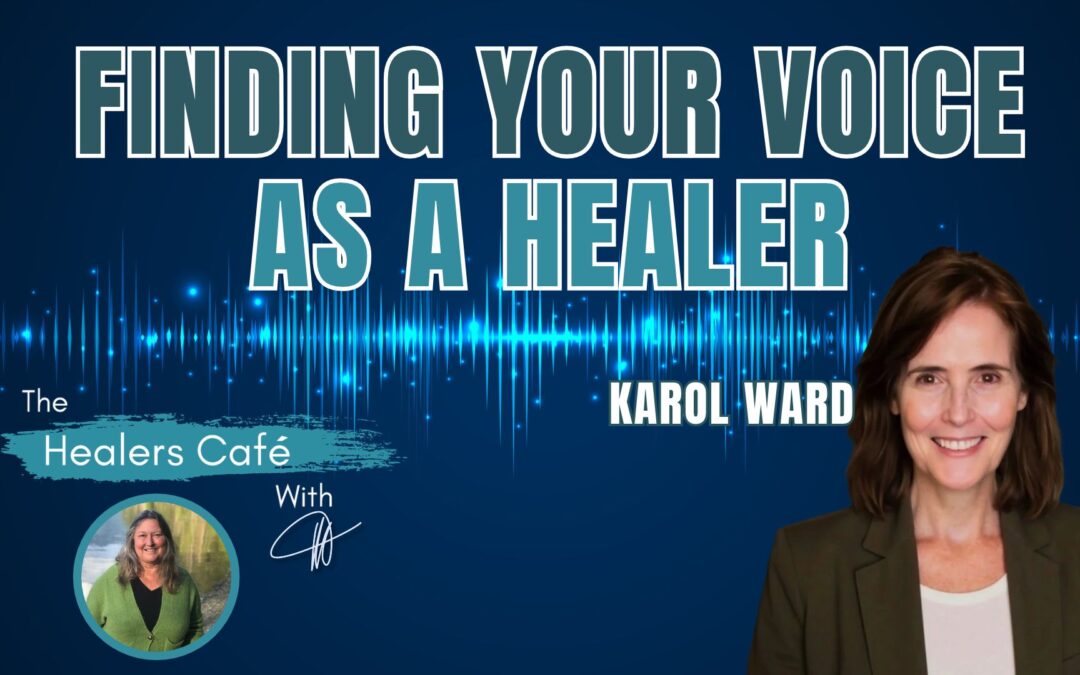
Finding Your Voice as a Healer with Karol Ward & Manon on The Healers Café
In this episode of The Healers Café, Karol and Manon explored healing as a practice that extends from therapy and naturopathy into corporate leadership, communication, spirituality, and emerging technologies.
Highlights from today’s episode include:
- Karol states healing belongs in every environment—even corporate—and she brings therapy-informed insight into leadership.
Karol explains our biggest block in speaking is self-criticism; real impact comes from communicating in our own style.
– – – – –
Manon talks about writing books and a TEDx talk helped free your voice by committing your evolving ideas to paper.

ABOUT KAROL WARD
My work focuses on the internal motivators of professional confidence; self-trust, creating visibility, and the ability to communicate under pressure.
As a TEDx speaker and author of Worried Sick Penquin and Find Your Inner Voice Career Press, I bring somatic psychological insight and combine it with practical, concrete application. My expertise has been featured in national media including CNN, NBC, The Wall Street Journal, Forbes, and other major outlets. Whether working with law firms, corporations, or speaking at professional conferences, my focus is the same: Helping professionals build confidence from the inside out.
Core purpose/passion: My core passion is speaking to audiences about how to create a deep well of confidence for themselves that is uniquely theirs. I love sharing psychological insights about what confidence is and then offering guidance on how build it at any point in life.
ABOUT MANON BOLLIGER, FCAH, RBHT
As a recently De-Registered board-certified naturopathic physician & in practice since 1992, I’ve seen an average of 150 patients per week and have helped people ranging from rural farmers in Nova Scotia to stressed out CEOs in Toronto to tri-athletes here in Vancouver.
My resolve to educate, empower and engage people to take charge of their own health is evident in my best-selling books: ‘What Patients Don’t Say if Doctors Don’t Ask: The Mindful Patient-Doctor Relationship’ and ‘A Healer in Every Household: Simple Solutions for Stress’. I also teach BowenFirst™ Therapy through Bowen College and hold transformational workshops to achieve these goals.
So, when I share with you that LISTENING to Your body is a game changer in the healing process, I am speaking from expertise and direct experience”.
Mission: A Healer in Every Household!
For more great information to go to her weekly blog: http://bowencollege.com/blog.
For tips on health & healing go to: https://www.drmanonbolliger.com/tips
SOCIAL MEDIA:
– Linktr.ee | Rumble | Gettr | Facebook | Instagram | LinkedIn | YouTube | Twitter |
About The Healers Café:
Manon’s show is the #1 show for medical practitioners and holistic healers to have heart to heart conversations about their day to day lives.
Subscribe and review on your favourite platform:
iTunes | Google Play | Spotify | Libsyn | iHeartRadio | Gaana | The Healers Cafe | Radio.com | Medioq | Audacy |
Follow The Healers Café on FB: https://www.facebook.com/thehealerscafe
Remember to subscribe if you like our videos. Click the bell if you want to be one of the first people notified of a new release.
* De-Registered, revoked & retired naturopathic physician after 30 years of practice in healthcare. Now resourceful & resolved to share with you all the tools to take care of your health & vitality!
TRANSCRIPT
Introduction 00:00
Welcome to the Healers Cafe, the #1 show for medical practitioners and holistic healers to have heart to heart conversations about their day to day lives while sharing their expertise for improving your health and wellness.
Manon Bolliger 00:44
So welcome to the Healers Cafe. Today I have Karol Ward with me, and her job title. I’ll just give that because that’s a it’s a powerful one. It’s confident communication and leadership consultant. So you can imagine all of the people that she helps, but her work focuses on the internal motivators of professional confidence, self trust, creating visibility, and the ability to communicate under pressure. Now she is a TEDx speaker and author of Worried Sick Penguin and Find Your Inner Voice Career Press, and she brings somatic psychological insights and combines it with practical, concrete applications. She’s been on all kinds of TV things, what some people would call fake news these days. Anyway, but there’s a lot behind her, and I think I’m not going to spend any more time other than to have Carol say a few words and welcome you to this show.
Karol Ward 02:04
Thank you. I’m. I really. I really appreciate this opportunity to talk about healing, in the sense of how it it has. What is it? It’s a net that goes far out into the world. It’s not. Oh, I just have I’m healing as a therapist, or I’m healing as a naturopath or an acupuncturist. I walk into corporate environments, focus on healing as well because it’s part of my training. So I think healing is important in all different environments. I know you know that as well.
Manon Bolliger 02:43
Yeah, no, no, but it’s it’s it’s well worth saying because you know we tend to segregate and separate and forget that we’re all you know whole, right? So exactly acknowledging that reality, and and I think it’s um it’s important too because often practitioners have the issue of not being seen in their own little milieu, right? But when you’re speaking to a milieu that maybe isn’t yours, you know, because you don’t have training in that, or you know you’ve never been really hanging out with those people, it takes other skills, you know, and so I think the work you do bridges that, from what I understand, you know.
Karol Ward 03:30
Absolutely, that’s a really good way of putting it. It, it, there is a bridge, and you know, I was in private practice as a therapist for many, many years, and I had a particular world and a particular focus, and then as I started to go out because it’s something that I like to speak about psychological topics, people started coming up to me and asking me, “One, tell me more about that topic, but also can you teach me how to speak? And I was like, “Oh, that is interesting, and so I started stepping more and more into the corporate world, which was not a world that I was in all the time. And I saw these are my patients; these are the clients that are going to be coming into your office. These are people; they aren’t, as you said, separate. And I learned to, because a therapist office is different from coaching in a corporate setting. Though people share deeply at times, I learned to cross over that make make that bridge between what’s appropriate for a therapy office and what is appropriate for a setting, which because of the environment isn’t letting someone let their hair down, but still holding this space for them.
Manon Bolliger 04:48
So that’s in introducing more subject matters, like from an informational point of view or from a therapeutic point of view.
Karol Ward 05:00
Informational, but my therapy training is always running in the background. And if someone is in front of me, when we go out to dinner, our backgrounds are running in back of us all the time.
Manon Bolliger 05:11
But if
Karol Ward 05:12
someone is in front of me in a corporate environment, and I see that they are struggling, while I I always say I’m not here to do therapy, but I can offer you some psychological insights if you’re open
Manon Bolliger 05:27
to
Karol Ward 05:27
- Often they are, and they are they are insights. It’s not a processing session,
Manon Bolliger 05:33
right? And then they
Karol Ward 05:34
take the information. I have to tell you, what’s really refreshing when I go into these environments is that a lot more younger people in session will say, “Oh, I said this to my therapist, or “I, I’m working with this therapist. Where years ago people didn’t share that kind of information.
Manon Bolliger 05:53
Right, right, yeah, interesting. You, you like as in it wasn’t as common to go to therapist, or the type of information itself-the
Karol Ward 06:04
type of information you would share in that kind of inf in that kind of environment. I’m sure people were in therapy, but you wouldn’t necessarily bring it up as-and I love this-as casually and matter of fact as some of the younger people, I coach. It’s they’re very, very comfortable with it. There’s a there’s a pressure that’s not on them that used to be there in the past, from my
Manon Bolliger 06:31
experience. Okay, so now you’ve got my curiosity going. Like what? Give me an example. Like of what what surprised you? What subject did you think that you know that before would not be discussed, and now it’s easier?
Karol Ward 06:49
Well, I think if someone shares with me, and again, I’m speaking very very general. Yeah, I speak about I coach in leadership or confidence. If someone says I’m having trouble communicating to my team about a particular task I want them …
Read more...
to complete, and and this is where having a therapy therapy background really helps. I assess that it’s not an intelligence thing and it’s not a strategy thing. It’s a hesitation thing based on, which I will explore generally with them. You know, this seems like this is a hesitation based on something within you, and then I kind of hold the space to see if that lands. And if they say yes, it is. I find fill in the blank being assertive, being being directive a struggle, and they might say it’s something I work on in therapy. So it’ll pop up in that way. Whereas in the past, the the environment was work is work, and personal is personal.
Manon Bolliger 08:00
Right. Right. Yeah. Yeah. yeah, yeah. Interesting, yeah. So, so, what do you find are the biggest, like, um, I guess hang up is the word I that’s coming to me, but there may be a better one that people have in communicating in those sort of milieux, like what what is it that holds most people back in your experience?
Karol Ward 08:27
Both in that environment and even when I work in life individually, is a couple of things. One is there’s a fear of assertion, asserting one’s opinion, asserting one’s thoughts, so there’s a holding back. What if I say the wrong thing? I think it comes back to self-criticism. I don’t know enough. I’ll say it wrong. I I can’t speak as well as somebody else. I compare and despair. So it’s that category of fear of self-criticism. The other thing that that comes up is people, and it really goes back to that last one. I should be speaking a certain way, and I don’t, and therefore something is wrong with me. My big thing is you get to communicate from your personality, your style, in your way. You may need to learn how to slow down, eliminate ums and uhs and words that are cluttering up your delivery, but you don’t have to become like anybody else in the room, and you can still be effective.
Manon Bolliger 09:43
Yeah, well, no, that that makes sense. I mean, I’m looking at it personally because why not? Why
Karol Ward 09:52
not? And I’m going to share a story. I I wrote about this. I actually one one time watched a. Practitioner, a health practitioner being interviewed on a local television show, and the host said to the practitioner, “You just exploring the subject. Said something like, “I hear that eating natural peanut butter is better than the store bought bought brand. It was something like that, and the practitioner said, “No, that’s that’s not good. You should be eating almond butter. And the host was sort of, “Where do I go with this? So, so they got into a conflict right away, and I thought to myself, “There’s a way to communicate
Manon Bolliger 10:42
with a
Karol Ward 10:42
host like yourself, or where you match the person, right? You know that we all know
Manon Bolliger 10:48
this. The
Karol Ward 10:48
practitioners know this. You don’t say to someone, “No, no, you’re doing it wrong. You say, “I can see your point, or “Yes, natural peanut butter is better than a commercial brand, and here’s another option as well. So there’s something about being able to relax into yourself, which then allows you to have attunement to another person, which allows you then to communicate and connect. I’m all about connection.
Manon Bolliger 11:21
Yeah, no, I think that’s a that’s interesting. I think I did learn that eventually, just because I couldn’t get out of my own way. It’s like I am who I am, and I really I want to understand people, I want to have you know. I want to have a discussion on the same subject. So let’s get clear what it is we’re discussing, what aspect of it, you know. So, and I think it comes naturally as a therapist. You’re listening, so your listening skills are relatively good.
Karol Ward 12:03
Yes.
Manon Bolliger 12:03
So therefore, the communication on the level of misunderstanding that that’s easier to get over. I mean, it’s it can be worked, but it it is also it can be very natural, right?
Karol Ward 12:18
Yes, I agree with that. The
Manon Bolliger 12:20
other part, where you know somebody could say it better, or you know, what if they’re yeah they’re more read in this particular subject, or all of the excuses, you know, where maybe your opinion is, you know, actually, that’s why I wrote books. So I decided I’m really going to push this. I did a TEDx talk as well, and I wrote four books. And now my thoughts are out there. That’s it. They’re in paper. They’re out there. Have I changed my mind on some subjects. Yes, have I gotten further educated? Yes, you know. Would I say it differently? Some some of the points, you know. But it’s it’s okay because now it’s like, oh, I finally did that step. But it took me writing it. Otherwise, I would be mumbling in the corner, wanting to say what somebody else was saying.
Karol Ward 13:27
And we all have our we all have our areas where that we get our voice out.
Manon Bolliger 13:32
Right, right.
Karol Ward 13:34
I love to speak literally presentations. I have written books. It’s not my natural thing, but like you, I wanted to share information without my thoughts.
Manon Bolliger 13:48
Yeah, no, and and the thing is, they can be you. You can do both, right? But I think therapeutically, the writing, the committing of on paper, is what allowed the verbal to come out.
Karol Ward 14:04
That’s interesting. Yes, it freed it up. Is what you’re saying?
Manon Bolliger 14:07
Yeah, because it’s not that I’m good at writing. It’s that it’s the commitment part that a thought can be shared, and yet can be changed. It can be wrong. It can be adapted to new circumstances, new realities, right? It’s it’s being less attached to to the ego in that sense, right? To what it means. It’s just a thought. Yes,
Karol Ward 14:34
just a thought. I agree. And again, it’s interesting that we’re talking about this because part of my it’s it’s an emerging focus. Meaning, I didn’t go into these environments going that this is what’s going to happen is to normalize worry, anxiety, and fear in those environments. Presencing for someone, normalizing, reflecting back-it’s okay. It’s okay for you to feel that way. I’ve seen it before. Now let’s talk it through. Work in a strategy. So it’s-it’s that-that’s how I’m hearing what you’re saying. It is really allowing people to digest what I’m saying and normalizing their experience, right? Whatever they’re going through,
Manon Bolliger 15:28
yeah. Which is, I think, it’s this is why it was easier to start with step two. Not that you had them in that order, but you know, the the the desire to connect First, and then you know, get more elaborate with the style of communication and the clarity of communication. It’s it’s sort of yeah, but if the heart’s not there, I think it’s very hard to jump that step.
Karol Ward 15:59
It is, and I and again, the heart opening in certain environments you can’t be wide open. It’s part of it would be too hurtful, but there can be a opening and assessing and can I share more? Can I share more of who I am in this environment? Because whether you’re in a therapy office, a naturopath office, a corporate environment, people are lonely, and they want to connect. They want to connect, and the ability to connect comes from sharing of oneself and to normalize that you can share yourself in your own way, and then learn some ways to connect people. To people really like that.
Manon Bolliger 16:46
So so, how long were you in practice before you really felt the calling? I guess to to share.
Karol Ward 16:57
I love that you said calling. I love that you said calling because I was in private practice for over 20 years. There was a what’s a dovetail, a crossover. There, I was doing both for a while. When I had the experience of speaking and giving presentations, I like this. I really like this format, and that is a calling of mine to share information from that skill set in those types of environments. And then from there, the the corporate coaching evolved, and I saw that I could use my therapeutic skills and also my communication training to combine them, as we’ve been talking about. But I love that. I love calling because I think calling is something that, for a while, it because I couldn’t. I was like, I’m a good therapist. I don’t. I don’t mind saying that. I was good at
Manon Bolliger 17:59
Manon Bolliger here, and I want to thank you for taking actionable steps towards engaging your healing journey and helping others discover their path by watching, sharing, subscribing, and reviewing these podcasts. Every review and share helps spread the word on these different perspectives and choices and options for healing, and to thank you, I’d like to invite you to sign up to my free seven sequence email tips on health and healing for everyday life, and you can go to healerscafe.com tips. Thanks so much.
Karol Ward 18:44
But I did, but it wasn’t lighting me up. It wasn’t lighting me up enough. And then when I started speaking, I would leave those events going, woo, lit up, lit up, and and kept paying attention to the calling.
Manon Bolliger 19:00
Yeah, well, I say calling too because to leave a practice it takes a lot, right? I think, anyways, you know. So it
Karol Ward 19:11
does.
Manon Bolliger 19:11
It’s got to be something calling you. It has
Karol Ward 19:14
to be. It has to be, and as you know, it’s it’s a change and a loss of an identity, but it is a transformation. I saw Stephen Levine speak years ago. I’m based in New York City. Spoke at the the Goal School Ethical Culture, and he was speaking about one of his books on death and dying. And my father had just died, and I was trying to understand it, and people were talking about change. And he said, “Your life’s work changes.
Manon Bolliger 19:50
What
Karol Ward 19:50
you did originally
Manon Bolliger 19:52
is
Karol Ward 19:52
going to change, and to go with that change, and it’s okay to go with that change. And there is that period of.” Relief, grief, and then change. Yeah, and that’s what that’s that was the big deal. Is oh, I I’m no longer the therapist. I’m this other thing. So I agree with you. It’s a big.
Manon Bolliger 20:15
Yeah, yeah. I’m I’m definitely in a transition now for a while. Yeah, absolutely. Yeah, because I I had my practice for 30 years, and then because of certain policies and things in Canada in BC where I I practiced, I could no longer do what I was doing without abiding to ethics that I did not have, so I I believe in informed consent and you know things like of that nature. So I I couldn’t do what I couldn’t do. So so then I I had to well it was a combination of resigning but also not playing along with something I just will not be seen in. You know, it’s just it’s wrong. Yes, and so we’ll see what happens with all this. But now it’s um, I can see because Bowen therapy is a big part of my life as well, I have a school and I teach it, and it was a big part of what I do in my practice. And now, with all the technology that is resurfacing, a lot of it has been in existence, but we’re getting to see it again. These med beds are coming, and meds. What is
Karol Ward 21:46
that?
Manon Bolliger 21:47
It’s basically a cellular regeneration through frequency, way more advanced than what, in general, we know. But the knowledge has already been there. It’s just you know how sometimes knowledge gets destroyed for usually for monetary reasons. You know anyway it’s a it’s a bit of a dark world if you look at it on one level, and it’s hard to miss that level when you’re in it when you see it. But anyway, this is all coming out again, and it’s been very interesting because my whole life is so tactile. It’s it’s about connection, it’s about heart, it’s about touch, and this is now in people healing from all kinds of conditions and cancers and whatever in in like half an hour in this technology that I barely understand. I mean, I understand frequency. I get the idea. You know, it’s not. I mean, the concept’s been around, but there seems to be so much that people are going to need to be able to relax into that environment, or maybe not, right? Like, well,
Karol Ward 23:15
maybe not. You’re right.
Manon Bolliger 23:16
Like they’re looking new world, you know.
Karol Ward 23:19
Yeah, people are people are craving connection and contactileness,
Manon Bolliger 23:26
right? But here it’s almost the opposite because you’re in a little, in a, in a spaceship basically. So there’s like no touch, and you’re on your own, right? And I mean, you’re. I’m not saying there’s no nobody in the room, but it’s um it’s it’s all the opposite of what I’ve always
Speaker 1 23:49
done, and
Manon Bolliger 23:50
yet I feel extremely called to really participate in this. Well, because of the results. I mean, you know, if you can heal that many people that quickly, you know, and stop this chronic disease management that we’ve been under, I mean, I hear it. That’s my calling. So, so it’s it’s an interesting kind of world, and you know how to step into that, and yeah, it’s a it’s a dance, right? It’s
Karol Ward 24:26
and you sounds like one the calling you’re you’re listening to the calling, and you’re open to seeing because you’re open. Information will come to you in forms, many forms, different forms, dreams, people, symbols, right? It shows up in in many different ways.
Manon Bolliger 24:48
No, and it’s funny. Like dreams, it’s true. It’s like I have, you know, different types of scenarios playing out in dreams, just because it’s not manifest yet. You know, as in I’ve. Pictures, but I haven’t seen one. I haven’t touched one. I haven’t tried one. So it’s it’s very interesting. And this is a Japan. Actually, is the first country now that will be bringing that into their entire population. They have also have the eldest population, and in September they it will be in every hospital.
Karol Ward 25:25
I’m going to pay attention to that now. I’m trying to energy
Speaker 2 25:29
work,
Karol Ward 25:29
and years ago, years ago, I I got under an orgone blanket created by developed by Wilhelm Reich, who was the father of somatic therapy, yes, and it was it was intense. And my a therapist I knew had been given it was a container. It was I think it was
Manon Bolliger 25:56
a
Karol Ward 25:57
triangle container, and he had it in a room of his apartment, and had to and had to remove it because he was just being bombarded with energy. So there are all of these modalities. Yeah, you’re right. Have been in existence, and now I hear from you coming out from being underground.
Manon Bolliger 26:19
Yeah, no. So it’ll be, it’ll change our world. That’s for sure. You know, and and how we relate to it. You know, and you know, it’s it’s easy to say, oh, technology, it’s all bad. It’s not. It’s it’s a thing, and we have to understand who’s it. I think it’s who’s in charge of it, is a big part of it. You know, it’s like if it’s centralized or decentralized, that’s hugely different. You know what the damage that can happen, right? And I think it’s um it’s a time where we really have to evolve quickly to stay, you know, up with what’s happening because it’s feels like it’s going so fast,
Karol Ward 27:03
and what comes to mind as well, and we have to be able to hold on to ourselves.
Manon Bolliger 27:08
Well, that’s it. Hold
Karol Ward 27:10
on to ourselves. Does this feel right? What am I drawn to? Does this feel wrong? I mean, exactly.
Manon Bolliger 27:17
And that’s why that first level of, you know, you really-if you really want to know the other to communicate-that keeps you grounded, and the rest is kind of-it’s just skill sets. It’s just or stories, things we can let go of or move through. It’s-it’s a different nature, you know. But all we really have is ourselves, you know.
Karol Ward 27:40
Absolutely, I wrote about something where I shared that when I was first in private practice, I was energetically and verbally trampling all over my patients, wanting to fix them.
Manon Bolliger 27:54
Right, right.
Karol Ward 27:55
It was so hard for me to sit in their discomfort and their need to process. And that therapist I mentioned, he was my supervisor, said, “You have to fix it right away. Just sit there in silence and match and match and match the person, and you’ll then you’ll be led to the next thing. It doesn’t mean that we throw our skill set out the door. We’re constantly assessing and evaluating, but we let the patient lead, and that’s the same with communication. We let the person lead. That doesn’t mean we get trampled on in a in a dynamic, but cues and listening and paying attention lead us to connection.
Manon Bolliger 28:43
Yeah. Well, it’s interesting. It’s actually a principle by Samuel Hanneman in homeopathy of mirroring like cures like, right? So holding the likeness is allowing the transformation to take place, which is interesting. It’s very
Karol Ward 29:05
true. And as a complete side note, but very much related, when I was in my 20s, I worked for a naturopath in New York City. I was his assistant. I would sometimes do for patients who couldn’t do it for themselves. I was the surrogate muscle tester,
Manon Bolliger 29:24
right,
Karol Ward 29:24
right for different remedies, and so I learned a lot. It it was part of my exploration of somatic therapy, and it it was another piece of that training,
Manon Bolliger 29:34
right? Yeah, yeah, no, it’s fascinating. I realize our time is almost out, and I absolutely need to ask you a question. So you said this is what had most impact, and your second point is what I’m going to ask you on. I had an anesthesia injury which opened me up spiritually. Could you share that? Do you mind?
Karol Ward 30:02
Not at all. About let’s say four years ago, I had unexpected surgery, and I’m a very very sensitive person. I I feel an aspirin enter my system. I rarely take things, and I had anesthesia, and I asked for certain things not to be used. I didn’t want a benzodiazepine used. I didn’t want an opiate used. Yeah, but I’m not an anesthesiologist, so I didn’t know that they would use a steroid, use propanol, something else, and I became incapacitated. I became completely mentally and physically incapacitated. I was bedridden for three months.
Manon Bolliger 30:50
Jeez,
Karol Ward 30:51
could not go outside because it was overwhelming. My nervous system was shocked, and I felt very abandoned spiritually. It’s spirituality has been an area that I continually try to develop, and I just was railing at God, universe, and then when I came out of it, it took six months, three months of intense symptoms. Then symptoms dropped off one by one, and when I came out of it, it was like the mist opening up for me. I realized that on some level, I stayed with it and went through the process because it was excruciating, and I had I had anhedonia. I don’t know if you’re familiar. Absence of joy, absence of feeling, different than than depression, just absent. So I would flat, flat, and when that lifted, I thought something kept me going. Something kept me going. I’m a determined person anyway, but but this really tested my
Manon Bolliger 31:57
life force.
Karol Ward 31:58
Yeah, my life force very much so. I mean, I I was reaching out to holistic practitioners, and it it my body had to heal on its own. It had to go through a process, and so when I say it opened me up spiritually, I I found myself, of course, with a deeper appreciation when when we go through something like that, and I found myself experiencing more, what I call synchronicity, which I’ve had my whole life. I’ve always had the ability to pick up on things that opened up even more. And I, I, and this sounds very simple, but I realized that someone was on my side, because some people don’t make it through crises.
Manon Bolliger 32:44
Yeah, not exactly. Yeah, yeah. Where the synchronicity is that this is not your time.
Karol Ward 32:52
This is not my time.
Manon Bolliger 32:53
Yeah,
Karol Ward 32:54
this is not my time.
Manon Bolliger 32:56
Yeah.
Karol Ward 32:56
Yes, and I heal from what I had the Surgery from I it was it was not spontaneous healing, but I healed
Manon Bolliger 33:05
and
Karol Ward 33:05
no other treatments were recommended and I couldn’t go. I couldn’t go, so I my body and mind came back online and something was something or somebody was in my
Manon Bolliger 33:19
com. Yeah, very good. That’s quite the experience. Yes.
Karol Ward 33:28
So I, I really, it’s made me more compassionate and open and sensitive and protective of my energy because, as we know, just because we care, we’re in the healing profession. We can give, give, give, give, give, and one of the most important thing when I work with practitioners is have to set the boundary for yourself. It’s okay to say no. Not every patient is the right patient. Not every situation is the right situation. And in my case, even with the holistic treatments I was turning to, not everything that is good for you is good for you in at that time.
Manon Bolliger 34:05
Exactly. Yeah. Yeah. Yeah. No, it’s a great unwinding and and personalizing. You know, it’s true because it’s it’s you can have something that works beautifully at one moment, but not at all at another, and you think, “Well, did the therapy not work, or was I not ready for it, or was it not the right time in my timeline? Exactly. Exactly. I don’t know. I don’t
Karol Ward 34:32
know. And sometimes doesn’t matter. You’ll you’ll get the answer later on. Later on, you’ll go. Oh, that’s why.
Manon Bolliger 34:38
Yeah. There’s a lot of later on happening in therapy. So much we don’t know. Yes. Anyway, Carol, thank you so much for spending this time and explaining partially your work. I think we did cover it a little bit.
Karol Ward 34:56
We did cover it and talked about how healing shows up in many. And yes, it’s been wonderful to talk about some of those reasons that I like what I do and had switched. Yes, I agree.
Manon Bolliger 35:09
And then I noticed too, you have a free five minute body mind audio download. Is that still available for people? It is
Karol Ward 35:16
still available. Yes, it’s it’s five minutes. It’s it’s something you can do in your car and the train and set to some very soothing, original music, and it’s it’s just really to calm things down,
Manon Bolliger 35:31
right? And also cultivating confidence and calm. I mean, both. Yes,
Karol Ward 35:36
once if you’re scattered and going, what do I do? I don’t. What do I just to calm first? Calm, not not Zen maybe, but calmer, so that you can then feel more confident.
Manon Bolliger 35:48
Okay, good. Well, thank you very much, and yeah, I’ll let you know when it when it airs.
Karol Ward 35:54
Perfect. Thanks so much.
Ending
Thank you for joining us at the Healers Cafe. If you haven’t already done so, please like, comment and subscribe with notifications on as I post a new podcast every Wednesday with tons of useful information and tips for natural healing that you won’t want to miss, go to DrManonBolliger.com/tips for more tips