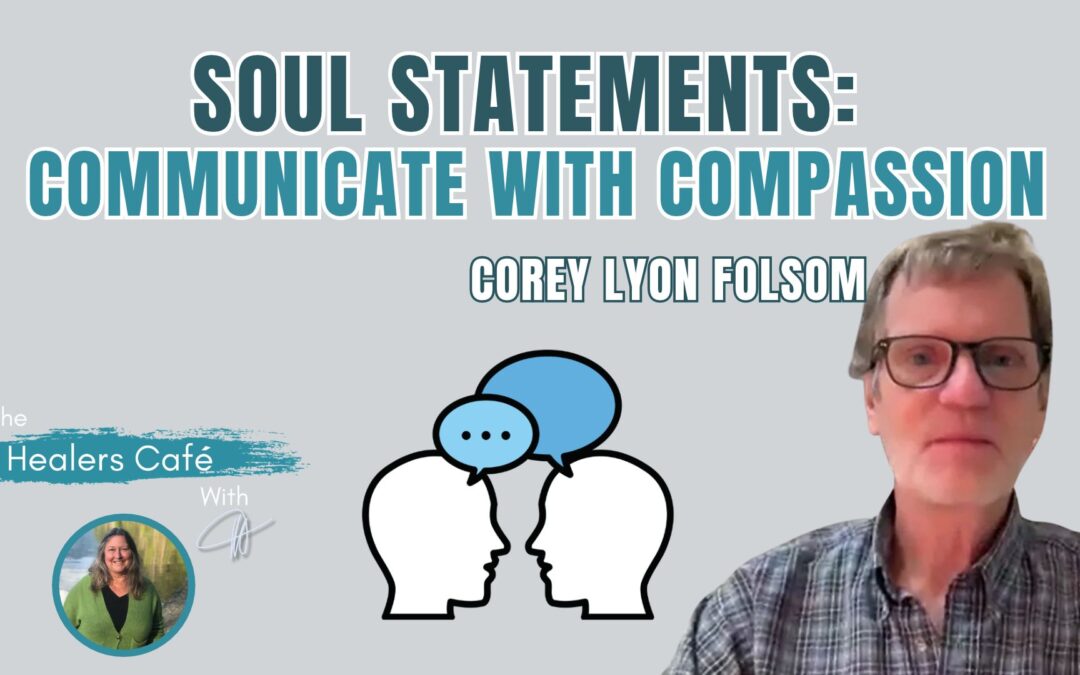
Soul Statements: Communicate with Compassion with Corey Lyon Folsom & Manon on The Healers Café
On This Episode of The Healers Cafe, Corey and Manon discussed relationship coaching, communicating with empathy, and tools for building self-awareness and self-care.
Highlights from today’s episode include:
Corey: Better conversations start with “I” statements—share your experience and make a request without blaming the other person.
Corey: Challenge critical self-talk with what’s actually true, and meet others with curiosity instead of criticism.
– – – – –
Manon: She highlighted that compassion and finding ways to relate can help people move beyond staying in their heads and connect with their feelings.

ABOUT COREY LYON FOLSOM:
Corey Lyon Folsom is a certified relationship coach. He’s also been a wilderness guide for newly sober people and a vision quest leader.
After a spiritual soul-awakening, Corey participated in Non-Violent Communication, Source School of Tantra Yoga, Love Coach Academy, Tony Robbins and other programs. He’s passionate about helping people expand their empathy, clarity and communication skills. Corey is the father of two grown sons.
His award-winning book, Soul Statements: A Love Coach’s Guide to Successful Communication, is a practical guide for making small shifts that produce outsized benefits in life and love. Each chapter has a wealth of potent tools for upgrading communication, mindfulness and connection with life.
Core purpose/passion: I’m passionate about helping people expand their empathy, clarity and communication skills. A core practice is learning to curate the messages that you tell yourself.
ABOUT MANON BOLLIGER, FCAH, RBHT
As a recently De-Registered board-certified naturopathic physician & in practice since 1992, I’ve seen an average of 150 patients per week and have helped people ranging from rural farmers in Nova Scotia to stressed out CEOs in Toronto to tri-athletes here in Vancouver.
My resolve to educate, empower and engage people to take charge of their own health is evident in my best-selling books: ‘What Patients Don’t Say if Doctors Don’t Ask: The Mindful Patient-Doctor Relationship’ and ‘A Healer in Every Household: Simple Solutions for Stress’. I also teach BowenFirst™ Therapy through Bowen College and hold transformational workshops to achieve these goals.
So, when I share with you that LISTENING to Your body is a game changer in the healing process, I am speaking from expertise and direct experience”.
Mission: A Healer in Every Household!
For more great information to go to her weekly blog: http://bowencollege.com/blog.
For tips on health & healing go to: https://www.drmanonbolliger.com/tips
SOCIAL MEDIA:
– Linktr.ee | Rumble | Gettr | Facebook | Instagram | LinkedIn | YouTube | Twitter |
About The Healers Café:
Manon’s show is the #1 show for medical practitioners and holistic healers to have heart to heart conversations about their day to day lives.
Subscribe and review on your favourite platform:
iTunes | Google Play | Spotify | Libsyn | iHeartRadio | Gaana | The Healers Cafe | Radio.com | Medioq | Audacy |
Follow The Healers Café on FB: https://www.facebook.com/thehealerscafe
Remember to subscribe if you like our videos. Click the bell if you want to be one of the first people notified of a new release.
* De-Registered, revoked & retired naturopathic physician after 30 years of practice in healthcare. Now resourceful & resolved to share with you all the tools to take care of your health & vitality!
TRANSCRIPT
Introduction 00:00
Welcome to the Healers Cafe: Conversations on Health and Healing at Manon Bolliger, a retired and deregistered naturopathic physician with 30 plus years of experience. Here you will discover engaging and informative conversations between experienced healers, covering all aspects of healing, the personal journey, the journey of the practitioner, and the amazing possibilities for our own body and spirit.
Manon Bolliger 00:44
Welcome to the Healers Cafe, and today I have with me Corey Lyon Folsom, and let me just tell you a little bit about him. He’s a certified relationship coach. He’s also a wilderness guide for newly sober people, and a vision quest leader. After a spiritual soul awakening, Corey participated in nonviolent communication, Sour School of Tantra Yoga, Love Coach Academy, Tony Robbins, and other programs. And he’s passionate about helping people expand their empathy, clarity, and communication skills. He’s also the father of two grown sons, and I believe also the author of a book quite recently, Soul Statements, and what is it? A love a love guide,
Corey Lyon Folsom 01:43
a love coach’s guide to successful communication.
Manon Bolliger 01:46
Okay, awesome. And then also a card deck of cards for soul statements. Okay, cool. I’m curious about that one too. Okay, well, why don’t we go a little bit into your journey, how you got to this place, and yeah, yeah.
Corey Lyon Folsom 02:08
Well, gosh, it’s I I grew I was born in Boston, but I grew up most of my childhood in coastal Maine, so small town America, church on Sundays, Eagle Scout, and but I was intensely interested in the natural world. I would go in the fields and woods behind our house before school just to listen to the birds, and and you know built a log cabin with an ax. You know when I was 15 or 16, and and just I was out there trying to be quiet, trying to listen and be still, so the natural world could, you know, be experienced as if I wasn’t there. And sometimes, and so I just had lots of young adventures, and when I moved from there, I ended up in northwestern New Jersey in the Kittatinny Mountains, working for a wilderness survival training academy, if you will, called the Tracker School, and we learned about edible plants and making fire without matches and tracking animals and shelters and clothing and you name it. So that was three years, really intensive, deep immersion into that world. And my best friends today are from that time. And so then I bounced out to the west. So first in Idaho, eventually Montana, Colorado, Utah, Arizona, and actually leading expeditions. So three weeks, yeah, epic. Three weeks, six weeks longer with youth at risk, and then also with early early people and early sobriety. And so, when you mentioned being a wilderness guide and vision quest leader, that’s past tense. Right, that’s what I did for those years. And so I learned all these things. I learned so much about being a leader, dealing with the unpredictability of nature and and just things that happen that are unexpected, and how we deal with it as a group, as a pseudo family, how to resolve conflicts and address bad behavior, and so it was all just a big learning. And I
…
Read more...
met my future wife doing that, and we raised two boys in Moab, Utah. They’re 33 and 30 now, and so. So there’s another chapter of increasing my emotional literacy, my access to my emotions, if you will, and so just eventually I just put it all together and started coaching couples and singles. A lot of people who maybe wanted weren’t in a relationship but wanted to maybe meet someone special, and they were smart enough to realize, well, that person’s not here. This is the perfect time for me to work on being a special person, you know, having a relationship with myself, and stopping doing things that aren’t good for me. Like abandoning my values, not speaking up for myself, not using my voice in defense of my heart. Those kind of things, and so that just kind of led into more and more coaching. And eventually, I tried to put most of my best stuff into a book, Soul Statements, and I coin the term soul statements to it’s a it’s something that you can find and remind yourself of that’s true and is always true about you. And so it’s not an affirmation of oh I want to be here or get there. It’s just like oh I have a loving heart. Why not remind yourself of that when you’re feeling less than? And I can call upon the grit inside me. I am not what I complain about. So those are soul statements that you can, you know, pull out of your back pocket when you’re feeling some form of helpless or hopeless. And a book was born.
Manon Bolliger 06:42
Yeah, interesting. And and what is it you you found? I mean, this came like as it seems almost like a download from you and your experiences. But what is it that most people that come to you for coaching? What is it that you see? That’s you know that they want to work on, or that’s lacking in their way of looking at themselves or their their universe.
Corey Lyon Folsom 07:13
I would say it’s probably self talk, and you know that bravery to have awkward conversations,
Manon Bolliger 07:23
right? Okay,
Corey Lyon Folsom 07:25
and and part of that hesitation to have an awkward conversation is if well, if you don’t have enough skills to make it go well, then maybe you’re better off not not even going there. And so you know I can work with people on well let’s there’s some basic building blocks that help conversations go better like not starting sentences with you so that’s like a verbal finger point but maybe start with I maybe just talk about my experience what it was like to be me when X or Y happened. So you’re not assigning blame. You’re not saying, you know, you. I’m not evaluating your behavior and saying, well, you. Not describing what anyone else did. Just this is what happened, and this is what occurred for me, and hopefully we can. It’s it’s a lot easier to get to a request in there because you’re not, you know, pigeonholing this other person into the the bad one. You’re just like, hey, this happened. You know, I didn’t hear from you. I got worried, and I don’t want to feel feel that way. I really was concerned. Would you be willing to stay in better touch going forward? You know, if I don’t know where you are or whatever it is. So that’s just an example.
Manon Bolliger 08:56
Right. Right. Okay. Okay. And those cards. I’m curious.
Corey Lyon Folsom 09:03
Yes.
Manon Bolliger 09:04
Yeah. So, what? How do they? Like, how would a person use them in? Like, I guess. Yeah. Like, you you mentioned a little bit like reminders, but how do you choose the one that’s right for you. How does that work?
Corey Lyon Folsom 09:22
Yeah. Well. So this the soul statement card deck is from most of them. Probably two thirds or three quarters of them are from the book, and then others are soul statements that I created in the process of making the deck. So it was a really joyous process. And when you feel yourself, you don’t have to be in that downward spiral of feelings, and you could just think to yourself, you know, I want to be inspired. I, you know, the best parts of me. I want to listen to the the competent me versus the critical me, or whatever you say in your head, and say, you know what, I’m going to pull a card. And what I do is I I shuffle and I I I think to myself, what would be helpful for me to know or consider right now. So I’m going to do this right now. What would be helpful for me to know or consider? And I have my innermost self knows what to do.
Manon Bolliger 10:42
And underneath, my purpose is clear when I am attuned with my heart. When I am present for myself, I have more to give. It’s like, oh, that’s a really good thing to ponder. My innermost self knows what to do, and it’s like, okay, yeah. So you could use this, like let’s say that we were, well, we are having conversation, but let’s say it became awkward or whatever, you know, like it could be in true life, right? And you’re like, ooh, let’s. Why don’t we get an kind of an insight and what might be going on for us to to resolve or to continue this conversation. So you might read that for yourself, and and then change slightly your behavior or the way that you approach it because of that insight. Sort of is that?
Corey Lyon Folsom 11:40
Yeah, we you could certainly do that. I just pulled another one. I can rise above
Manon Bolliger 11:45
tension. Yeah, yeah. It says
Corey Lyon Folsom 11:49
I am wiser than my fearful thoughts. My center can inform my next action, and so somewhere in there, there’s this kind of message that it’s good to spend time in your center, and basically, I I describe it as do whatever connects you to you. You feel more centered and grounded, and and just inhabiting your own life, not being confused by other things that are going on, and so for some people that’s sitting on a meditation pillow, or gazing at a candle, or journaling, strolling in the park, getting in the water, and or a hard workout even, and so because I’m just a fan of doing more of the things where we hear that little voice or that just that knowing. It’s like, oh yeah, that’s who I am. That’s what I am. That’s why I am. It’s what I’m made of. Right. And so, yeah. And so the it’s that stillness. When we can achieve it, we can we can have something then. And so you can write it down as your own unique soul statement, or you know you can just use the cards to find one that really resonates For you, yeah. And here’s I love this one. I can choose better thoughts.
Manon Bolliger 13:27
Right, that’s simple enough. Yeah, yeah, yeah. Yeah, yeah. Okay, do it. Go ahead and shuffle, and I’ll tell you when to stop. Okay, all right. Okay, I’m gonna try that. Let’s see. Okay. Okay, stop.
Corey Lyon Folsom 13:46
Oh, there was one in my hand, just about to. So, what does it say?
Manon Bolliger 13:50
I can breathe love in and feel it calm me.
Corey Lyon Folsom 13:55
Yeah, and then underneath, my heart offers me emotional coherence. Love will lead me to my ease.
Manon Bolliger 14:03
Yeah, very true.
Corey Lyon Folsom 14:07
Yeah,
Manon Bolliger 14:07
yeah. But that’s interesting. Yeah,
Corey Lyon Folsom 14:10
yeah. And so they’re really powerful and reminders of like, oh, yeah, maybe I could spend a little more time breathing love in, allowing it to calm me.
Manon Bolliger 14:23
Right, right, yeah,
Corey Lyon Folsom 14:25
yeah,
Manon Bolliger 14:26
yeah, yeah. Because I was thinking the nonviolent communication. I mean, that’s such a key part to communicating with other people. Like they have lots of fantastic suggestions there. You know. Yeah,
Corey Lyon Folsom 14:42
right. And NBC or or cnbc.org has a whole. I actually printed this one out. Emotions connected to unmet needs, universal needs, longings, and values. So it’s a great thing for. Building that kind of vocabulary to like, well, you know, instead of sad, mad, hungry, right? You know, there’s a whole list of other feelings and needs that might be a better descriptor.
Manon Bolliger 15:18
So, so in your experience, how long does it take for someone? And I know, I mean, the answer is it depends, and and there’s no, you know, Manon Bolliger here, and I want to thank you for taking actionable steps towards engaging your healing journey and helping others discover their path by watching, sharing, subscribing, and reviewing these podcasts. Every review and share helps spread the word on these different perspectives and choices and options for healing. And to thank you, I’d like to invite you to sign up to my free seven sequence email tips on health and healing for everyday life, and you can go to healerscafe.com tips. Thanks so much. So I get that, but if if you were to say on average, a person that comes in, they’re having a terrible relationship because they’re not able to relate anymore, right? And how long do you find that it takes for a person to finally see it another way yet again?
Corey Lyon Folsom 16:41
If I had to give an average, I’d say three, three sessions. I’ve had people that have one session and they get this most wonderful nugget, and like, great, that’s what I needed. Thank you so much, and then that’s it, and that’s awesome. And then you know, I’ve had other people that like that are working through a time in their life when there’s a lot going on, and they’re maybe they’re moving into a new area, and they’re getting a divorce, and they and so they’re helping. They’re you know every couple weeks they might talk to me about what’s come up and these problems with the gardener and who’s you know said this or that or you know and so you know I might work with somebody longer if that’s what they want and but the the the really the goal is to be more in love with yourself be more committed to taking good care of yourself, and you know that’s all you know. Well and fine to say, but there’s a lot of practical steps and skills and things you can do to actually, you know, put put the put that into action and make it real.
Manon Bolliger 18:00
Hmm. Actually, it might be interesting. I don’t know if you have it down that way, but like, if you were to say, you know, the top three or five things to consider, like, do you can you finish that sentence
Corey Lyon Folsom 18:14
in in with regards to
Manon Bolliger 18:18
to what we were just talking about, like to um, I guess. getting your life back in in order where you’re acknowledging yourself you know as well and your needs and
Corey Lyon Folsom 18:31
sure so I would say one would be not just letting unhelpful thoughts go by unchallenged and so what I do personally is when I have some, I find myself catastrophizing or just thinking something of some unhelpful thought. I’ll say, “I used to believe that, and what’s actually true
Manon Bolliger 19:00
is right.” And
Corey Lyon Folsom 19:00
then I’ll give my brain a better message, something like, you know, what’s actually true is I am enough, or what’s actually true is I can do this or I got this, and so, and it and the the words are one thing, and that’s good, but if you want to really turn it into power, you you’re declaring it as a truth to yourself, and then you you and allow yourself to feel it in your body, like like that’s I feel that that’s true, that I am enough, and the feeling that comes with that, the agreement that your body and your heart have is what makes it like find its right place in you. Like it
Manon Bolliger 19:50
sticks,
Corey Lyon Folsom 19:50
yeah, yeah. And and so and and so you’re just the more you can align with the capable you instead of the critical you. To the good, and so just challenging those thoughts, not just letting them drift by unchallenged.
Manon Bolliger 20:07
Right,
Corey Lyon Folsom 20:07
and the other thing is being honest with yourself on the inside, so not just lying like like I used to do of well, you know, I I didn’t really want to, or it wasn’t a good time, or done it, or I some form of I wasn’t, or I didn’t, or I. The fact is, I was scared,
Manon Bolliger 20:33
right? And I
Corey Lyon Folsom 20:34
chickened out. I didn’t speak up. I didn’t make the move, and here I am. And the fact was, I was scared, and I I wasn’t. I didn’t feel like I could, and that was a lie that I was telling myself. And I could, and the truth is, I could have. Right. So, so that’s that’s the second thing, and and also also, I think there’s you know more than just things you can do. There’s an attitude. I guess you could say that self honesty is an attitude, but also the attitude of you know I’m Responsible for my diet of information of what I allow myself to think, and not just you know my exercise and my sleep and all that, but I’m I’m responsible for my thoughts and for and my actions, and so that in that allowing other people the grace of, you know, I didn’t grow up in their body, maybe in their neighborhood with their bullies and their friends and their teachers and their parents and their body and all this whole thing. I didn’t have that. Of course, they’re going to respond or react in a way other than I would, because of how they got here, and so and just remembering and going oh and trying to be a little more curious versus critical of others, and so if if somebody like my partner is touchy or you know unhappy, instead of saying, “Well, you should or you shouldn’t do this or you shouldn’t say that or you shouldn’t feel that way,” being like, “Just get curious, right?
Manon Bolliger 22:36
Yeah,
Corey Lyon Folsom 22:37
I’m curious what’s going on.
Manon Bolliger 22:38
Yeah, you know,
Corey Lyon Folsom 22:40
and just listen to what they and then just mouth closed, listen to what they say, and so that attitude of, hmm, they’re not a defective version of me; they’re their own, you know, being their own sovereign person. And so, just the more you can be interested and curious about how they got where they are in this moment will take you a good long way in toward. Oh, I I understand. And and the thing is too, when you’re say if you’re experiencing something you don’t want to experience, instead of like I said before, pointing that finger and saying you did this and you’re doing that, but say you know I’m feeling something I don’t want to feel, and when I hear that feel when I when my partner leads with a feeling word that catches my attention because if if she just goes oh these things I don’t like. Da da da da da. It sounds like like the teacher in sixth grade or something, and I’m not really listening because it’s just words and it’s noise. And but if if there’s a feeling word, I’m like, oh, feeling word. That’s important because I want her to feel well and good, you know. She’s here sharing my life with me, and so I want her to think, “Oh, that was a good decision.” So, and I care about her, and so, and also because if she says, “You know, I’m feeling exhausted,” it’s like, “Oh, well, I’ve felt exhausted before too, and so I can understand at least what it’s like to when I feel exhausted. And so all of a sudden, there’s a little bit more empathy, a little bit more. Oh, I I understand what’s going on. You’re feeling exhausted, and and I don’t want her to feel that. So then I’m more receptive to hearing what’s going on around that. If I if I if they lead with the feeling, that’s a good thing.
Manon Bolliger 24:47
And and how do you get a person who is in their head a lot to go to how do they feel? How do you do that without sound? Like you’re a psychiatrist, right, right,
Corey Lyon Folsom 25:05
right, and you know, I might say, you know, I hear what you’re saying, but I don’t really know what’s happening, or I hear what you’re saying, but I, I, I really want to know how you’re feeling, like because it’s you know you matter to me. So what’s you know what’s under all of this? And I’ve had good success with that as have my people. Yeah.
Manon Bolliger 25:36
Okay. Yeah. Interesting. Or or
Corey Lyon Folsom 25:40
you know, I under I hear what’s happening for you, and your feelings are really important to me. I really care about you, you know, you know, and just let’s let’s go through it together. And yeah, so and you just kind of it’s hard when you’re not in a very specific situation to make something up. Yeah. Yeah. You go
Manon Bolliger 26:07
to your head. Yeah. Yeah. Yeah. And forget the rest. Yeah. But it’s basically creating more compassion, like finding a way to relate.
Corey Lyon Folsom 26:19
Yeah. Or I might say, oh, and see, I don’t want to necessarily name someone else’s feelings. I that’s one of my big things. I don’t like other people doing for me. No,
Manon Bolliger 26:29
right. So
Corey Lyon Folsom 26:30
I won’t say, oh, you’re obviously angry, or you’re obviously no, you must be hungry, or whatever. But I might say, oh, I get that this is distressing for you. Like, yeah, and they can you know fit that into whatever’s going on. Like oh, you know what? I’m I hear that this is upsetting. That you’re you’re this is a problem for you right now. Like yeah, so right there, that’s a good place to start.
Manon Bolliger 26:59
Yeah, yeah, that’s a good one. Yeah, yeah, general enough, but you know, we’re caring enough. Yeah, yeah.
Corey Lyon Folsom 27:07
Like I’m putting my attention and I’m coming toward them with, oh, okay, I I see there’s something going on. And the other thing too is, if somebody’s having an issue, and it’s it goes a long way too if you actually turn your body and you’re you’re really facing them, not just oh yeah da da da da da, but they’re like I I’m here,
Manon Bolliger 27:32
yeah.
Corey Lyon Folsom 27:33
Let me hear what’s going on, and and that that helps. You know, trying to have arguments or heated Conversations passing through different rooms or whatever is just like a no bueno.
Manon Bolliger 27:46
I guess so. Yeah, I remember in one of my relationships, the best conversations where we could actually listen is when we were on the telephone. But at the time, they were telephones, right? That were wired, so not once you could, you know, walking down the street, right? Just so you’re kind of, you could still move and you could think, and you had your own space. And I think we resolved more by telephone than any other way, which is kind of funny.
Corey Lyon Folsom 28:23
Yeah,
Manon Bolliger 28:23
yeah, yeah, yeah, yeah. So we’re kind of near the end here, but I wanted you to share maybe one story or something that that touched you, or that you learned a lot from, or something, or something from your book, you know, so that people kind of get to know a little bit more about you.
Corey Lyon Folsom 28:47
Sure, let me think. I um. Oh, I. This is um, I this is one of my favorite bits in here on page 77. I may not be having an ideal day, but I am in it with the reasonable expectation of another day to live after this one. I hold the awareness that this very day I’m inhabiting is the best day of my life, every day. Other days may have held more pleasure, excitement, closeness, joy, or accomplishment. There have been days in my life that were filled with wonder, adventure, or more ease and connectedness than today, this day stands as the best simply because I am living it now. All previous days, whether amazing or difficult, have passed into memory. They are encoded in my cells and psyche, and they led me directly. To hear, each one of them informs my present, and it is the present day that matters most.
Manon Bolliger 30:08
Yeah, great. Well, thank you for spending time discussing your work and your path, and and then again, the name of your book and how people can reach you.
Corey Lyon Folsom 30:24
Soul Statements: A Love Coach’s Guide to Successful Communication. And my website is corerelationship.com. And there’s a page about the book. There’s a page for the card deck, and there’s about a couple dozen blog articles I wrote, and ones on giving good phone, by the way. And so yeah, that’s that’s the central place for all things me. The book is actually on Amazon or Bookshop.org or Barnes and Noble, all those places and the the cards are only available on Etsy, but there’s a link on my website.
Manon Bolliger 31:06
Okay.
Corey Lyon Folsom 31:06
Yeah.
Manon Bolliger 31:07
Well, thank you.
Corey Lyon Folsom 31:08
Indeed, it’s been a pleasure.
Ending 31:13
Thank you for joining us at the Healers Cafe with Manon Bolliger. Continue your healing journey by visiting thehealerscafe.com and her website, and discover how to listen to your body and reboot for optimal health.
Ending
Thank you for joining us at the Healers Cafe. If you haven’t already done so, please like, comment and subscribe with notifications on as I post a new podcast every Wednesday with tons of useful information and tips for natural healing that you won’t want to miss, go to DrManonBolliger.com/tips for more tips
* De-Registered, revoked & retired naturopathic physician, after 30 years of practice in healthcare. Now resourceful & resolved to share with you all the tools to take care of your health & vitality!