Simple Habits for Healthy Aging with Ronald Russell & Manon on The Healers Café
On This Episode of The Healers Cafe, Ronald and Manon discussed how his plant-focused cooking career informed his approach to longevity and an active health span.
Highlights from today’s episode include:
Ronald: Build healthy habits gradually, choosing nutritious foods you enjoy so the changes can last.
Ronald: Make dark leafy greens a daily staple—add them to smoothies, salads, or cooked dishes.
– – – – –
Manon: She highlighted that compassion and finding ways to relate can help people move beyond staying in their heads and connect with their feelings.

ABOUT RONALD RUSSELL:
Ron Russell is the author of Longevity Visa and founder of LongevityVisa.com — the passport to a longer, stronger, ageless healthspan. He’s a vegan chef who spent five years cooking for Dr. Dean Ornish’s UCLA cardiology patients, co-founded the award-winning SunCafe Organic in Hollywood, and has taught over 400 plant-based cooking classes. Today he separates real longevity science from the hype and turns it into habits anyone can actually use.
Core purpose/passion: Helping people improve their Healthspan with easy method to habit stack their way to health and longevity.
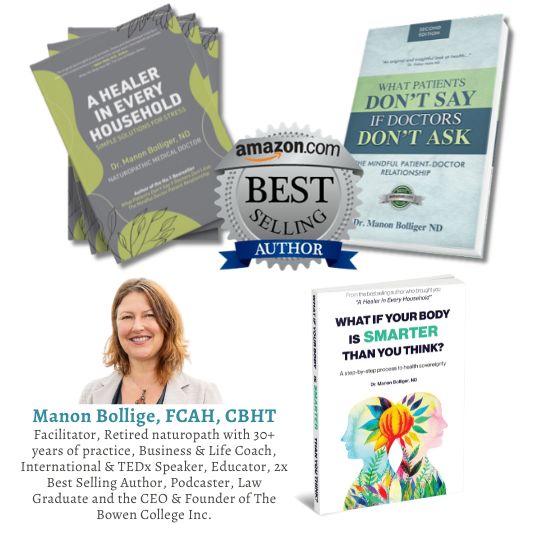
ABOUT MANON BOLLIGER, FCAH, RBHT
As a recently De-Registered board-certified naturopathic physician & in practice since 1992, I’ve seen an average of 150 patients per week and have helped people ranging from rural farmers in Nova Scotia to stressed out CEOs in Toronto to tri-athletes here in Vancouver.
My resolve to educate, empower and engage people to take charge of their own health is evident in my best-selling books: ‘What Patients Don’t Say if Doctors Don’t Ask: The Mindful Patient-Doctor Relationship’ and ‘A Healer in Every Household: Simple Solutions for Stress’. I also teach BowenFirst™ Therapy through Bowen College and hold transformational workshops to achieve these goals.
So, when I share with you that LISTENING to Your body is a game changer in the healing process, I am speaking from expertise and direct experience”.
Mission: A Healer in Every Household!
For more great information to go to her weekly blog: http://bowencollege.com/blog.
For tips on health & healing go to: https://www.drmanonbolliger.com/tips
SOCIAL MEDIA:
– Linktr.ee | Rumble | Gettr | Facebook | Instagram | LinkedIn | YouTube | Twitter |
About The Healers Café:
Manon’s show is the #1 show for medical practitioners and holistic healers to have heart to heart conversations about their day to day lives.
Subscribe and review on your favourite platform:
iTunes | Google Play | Spotify | Libsyn | iHeartRadio | Gaana | The Healers Cafe | Radio.com | Medioq | Audacy |
Follow The Healers Café on FB: https://www.facebook.com/thehealerscafe
Remember to subscribe if you like our videos. Click the bell if you want to be one of the first people notified of a new release.
* De-Registered, revoked & retired naturopathic physician after 30 years of practice in healthcare. Now resourceful & resolved to share with you all the tools to take care of your health & vitality!
TRANSCRIPT
Introduction 00:00
Welcome to the Healers Cafe: Conversations on Health and Healing at Manon Bolliger, a retired and deregistered naturopathic physician with 30 plus years of experience. Here you will discover engaging and informative conversations between experienced healers, covering all aspects of healing, the personal journey, the journey of the practitioner, and the amazing possibilities for our own body and spirit.
Manon Bolliger 00:44
So welcome to the Healers Cafe, and today I have with me Ron Russell, who’s the author of Longevity Visa and founder of Longevity visa.com. It’s actually the passport to a longer, stronger, ageless health span, and he’s a vegan chef who spent five years cooking for Dean Ornish’s UCLA cardiology patients, and he co-founded the award-winning Sun Cafe Organic in Hollywood, and has taught over 400 plant-based cooking classes. So I think with that we’ll we’ll just welcome you, and maybe you could share with us what started you on this journey.
Ronald Russell 01:41
Well, thank you so much, Manon. Yeah, it it started very young, surprisingly. My mother wanted to be a good mother, so she started reading before I was born nutrition books. She she didn’t know that much, and so she wanted to kind of you know give me a good start, and I look back and I don’t think of it as super healthy like I try to be now. But compared to my peers, it sure was. Never had lunch and meat, never had white bread, never had a Coke until I was 18 years old. So you know she did a lot of good basics, and it’s stuck in my head about nutrition and why not be as healthy as you can be. And so it’s been a lifelong journey of learning more about it and healthy lifestyle. And then then I opened the restaurant about 20 years ago, Sun Cafe in in Hollywood, and we started with only 20 seats, and we ended up growing to 150 seat restaurant with three patios. And every celebrity you can name came into my restaurant, and and it was a healthy, you know, you can be an unhealthy vegan and vegan, and you can definitely be an unhealthy vegan that eats, you know, potato chips and cookies all day long. But our restaurant was very health-minded, and you could go super healthy on our menu, or you know, moderately healthy, because we had to appeal to a large group of people. But and through that, I started getting people asking me about cooking classes, and so I started doing wellness and cooking classes. It wasn’t just about cooking; it was also about kind of getting people to understand, you know what was wrong, you know with, you know why they weren’t feeling as good as they should, and so that’s and then from there it grew into longevity and the whole longevity lifestyle. So that’s kind of the quick path I took, and then wrote the book about a six months ago, a year ago. Yeah.
Manon Bolliger 04:07
Okay. Interesting. So, I mean, it’s as good as you point out. There’s quite a range, you know, because my partner’s kids are both vegan, and and and what they brought home to eat. This is later, as you know, young young adults when they came to visit. One was all white, you know. It was rice and pasta, and you know, and oh my gosh, this is so not nutritious, you know.
Ronald Russell 04:37
Right. And then the
Manon Bolliger 04:38
other one, you know, had vegetables and and what was that called? Oh my goodness! Avocados and yeah, sure. You know, and seeds and things. And I thought, okay, okay, this is getting you know, this is like how is this related? But you know. You could really go the wrong way with vegan if you’re not educated, you know.
Ronald Russell 05:06
Yeah, sure. Well, with any diet, you can go wrong. Of course,
Manon Bolliger 05:10
of course. And so
Ronald Russell 05:11
you know, it’s it’s not that difficult, but you know, it takes some thought to it, and and it’s pretty obvious when you think about what the nutritious things are, and kind of what I’ve done is create a hierarchy of what the healthiest things are, in for
…
Read more...
myself, and then it kind of grew into the book. But I think of them there being two two parts. There’s the nutrition, and then the unhealthy part that you want to get rid of. So you want to gradually get the healthy part going up, and the the bad habits coming down. And I think of it as stacking your habit. You know, you want to just get into the groove of what’s healthy. Now, I’m a lunatic. I actually have a spreadsheet with 60 things I’m willing to do every day of my life on my longevity list. Now, I don’t suggest people start that way, but you know, start with one thing you’re willing to do in the nutrition category. For instance, like one of the things on my list is blueberries. I try and eat blueberries every day. Well, you know that’s not a difficult thing to do. I enjoy blueberries, and that’s what I would recommend to people. Find things that you do enjoy eating, or let’s say you’re not a big fan of greens, but find a way to make them tasty for you, or you know, so it’s like choosing the right things and what you’re willing to do and enjoy doing. I think is very important. If you if you hate whatever it is, avocado, definitely you don’t have to have avocado. Don’t feel like you have to force yourself because I don’t think that works long term. So I have substantial number of things I try and eat every day. There’s about 12 things that I try and eat every day, and then I try and avoid certain things. For instance, the biggest harms of health, in my opinion, are two main things. One is soft drinks and sugary drinks. I think those are one of the most damaging. And it’s not just sugar in soft drinks; it’s also the phosphoric acid and other acids that disrupt your gut health, and your gut health is very important to longevity and and your health span. So you want to really protect your gut. And then the other thing is fried food. I would say is at least very limited in your diet, definitely, you know, you see people that eat, you know, fried food at every meal. That’s just basically what you’re eating. Just so you know, I hate to say this, but you’re eating rancid oil is the problem with fried food, because to heat it high enough to cook, it turns it rancid, and rancid oil is full of radicals, which break down your cell structure. So that’s why it’s so bad for you. And then you know, eating, and
Manon Bolliger 08:31
also they they use coke, you know, not coconut, um, canola oil. Yeah,
Ronald Russell 08:35
yeah, right. You know, and yeah, unhealthy oils that are, you know, have all sorts of other problems, but yeah. So there’s those are two things that I think you know you should try and limit as much as you can, and ideally get rid of altogether. But and then maybe one other one would be heavily processed foods, especially processed luncheon meats, for instance. They’ve actually come out in studies saying that’s just as bad as smoking, eating luncheon meats. Well, that’s pretty bad because smoking takes about 10 years, a full decade off your life if you smoke. And same with luncheon meats, you’re probably going to lose about 10 years of your life. And I’m when I talk about longevity, I’m not talking about just living to 100 and being bedridden for 30 years. I want you to, you know, have a really active life right to you know the last day. That’s my goal. You know, so
Manon Bolliger 09:35
what what would be? I mean, I know they’re your 12, but what are just as an example of 12? You can share yours, or but what are the things you think are really good?
Ronald Russell 09:48
Let me back up and say what I’m trying to accomplish with diet is to have an anti-inflammatory diet. Most diseases start. Inflammation. There’s inflammation of some kind. Inflammation of the stomach. Inflammation of you know like acid reflux is a is inflammation of your throat, etc. That’s where diseases start. So if you can have an anti-inflammatory diet, then you’re going to reduce those risks. And and when I say cause disease, heart disease, cancer, diabetes are all linked to inflammation. So so that’s what I’m attempting to do with the diet. So you can easily look up what the anti-inflammatory foods are. the The most anti-inflammatory foods are probably dark leafy greens, things like kale and chard and bok choy and cabbage and all those things are really healthy for us. Especially the cruciferous vegetables, which have all sorts of other properties, such as they have a a compound in them that helps fight off cancer and other diseases, which most other foods don’t. They’re the most nutrient dense foods in the world. So, and I would also add into the dark leafy green seaweed. So any of those super dark green ones, and I emphasize dark because the lettuce is, you know, it’s good for you, but it’s not as nutrient dense as the dark greens.
Manon Bolliger 11:30
Right.
Ronald Russell 11:31
So, my recommendation, if you can, get a pound at least of leafy greens in your diet a day, and I know that sounds like a lot, and it is. But here’s how I do it real quickly. I I typically do one smoothie a day. I put in my vegan protein powder and you know my mushroom powders and my all these other things that I think are really nutritious for me. But I also make sure to put in a big handful of whatever green I happen to have on hand. Then I try and have at least one salad a day, and then the real tip is I tell people put dark leafy greens, chop them fine so they’re not like big hunks of them, and put them in everything. And what I mean by that is, you do a stir fry, you can throw in a handful of kale, and you’ll barely notice. Or you’re making enchiladas, you know, in the mix. You you know, with like I make enchiladas with bean and my own cheese, and I throw in, you know, chard or something in there, and I barely notice. Or you’re doing a casserole, or your almost anything you make, you can throw a handful of greens in, and so that’s a a tip I would suggest for people. And then also just learn how to cook it really simply. The way I typically cook a green is I always get a kick out of Southern Creole cuisine. There is no cuisine on earth that starts with healthier ingredients than Creole cuisine and ends up with a less healthy meal. You know, because what do they do? They take kale and collard greens and all these wonderful healthy things and cook them an hour and a half, and turn them dark brown. Get rid of all the green, and then throw in a pound of bacon fat. It’s like what the heck? So, here’s how you cook a green. You cook it until it wilts. That means spinach you cook for 40 seconds. Kale you cook for maybe a minute and a half before it wilts. As soon as it wilts, you’re
Manon Bolliger 13:41
done.
Ronald Russell 13:42
And then to make it taste good for me, maybe not for everybody, but I’ll throw in some pressed garlic, and garlic is also super healthy for you. Also, if you cut it or press it about 10 minutes before you put it in with the greens, it it activates all sorts of cancer-fighting compounds, and so you don’t want to cook it too much. So I typically just put it in after I’ve turned off the pan, and it warms it, and you know, makes it not quite so pungent. And then afterwards, not in my cooking. I usually cook it whatever green dry, and then afterwards I’ll drizzle some olive oil on it because you don’t want to heat olive oil because it has a low burn rate. So you you and it’s super healthy for you. So I think olive oil is probably the best of the processed oils for you, and but you know use it as a finishing oil is how I look at
Manon Bolliger 14:48
- And how do you feel about some of the seed oils like sunflower oil, suss oil? I mean, those were I know way back when I. Yeah, was raising my kids. You know, I thought I was doing all the right things. Yeah, sure. Tofu and drizzling it with after. Yeah, yeah, yeah. So I mean, the seed oils.
Ronald Russell 15:14
There’s been a lot of things coming out about it. I’ve also recently seen some pushback where they say, you know, it’s not as bad as it’s been made out to be. I think, I think, if you’re going to cook with oil, I think the oil to use is avocado oil. It has a high burn rate. You know, you can heat it decently high, and I haven’t heard any real negatives about avocado oil, so at the moment that seems to be the one I would cook with if you’re going to cook with oil. But I try to. Very rarely do I feel I need oil. A much better purchase to me is a ceramic pan. Nothing will stick to it. It has no toxic substances like Teflon has been linked to all sorts of problems health-wise, and also Teflon breaks down very quickly. Yeah, where where ceramic, I you know I’ve had no problems with ceramic pans, and it’s basically inert material, and so there shouldn’t be any real toxic substance to it if it’s like decently, you know, manufactured. And then, like I say, nothing sticks to it, so it’s great for cooking and even browning things you can do with with no oil. So anyway, that’s how I do my most of my cooking.
Manon Bolliger 16:47
Yeah, it’s interesting because I’m I’m definitely I’m not a vegan. I’m more I was raised as a you know organic produce in the garden and then farm farm to table, right? So you know you know what what the animals have eaten. Sure, they’re raised. You know, so it’s not factory
Ronald Russell 17:08
farmed and all that. No,
Manon Bolliger 17:09
exactly. So because I mean, there’s so many issues with meat. Yeah,
Ronald Russell 17:14
not just how the animals are treated, but just the actual what’s the end product is is very questionable.
Manon Bolliger 17:20
How they make it, you know? Yeah,
Ronald Russell 17:22
there’s there’s lots of issues, especially with chicken. I feel they’re in such poor condition and so much feces that it’s estimated that roughly half of all chicken that goes to the market has is cancerous. Not that you’re going to get cancer by eating a cancerous chicken, but what I mean is, it’s it’s not the healthiest meat you can eat. So you know, be be be aware of if you’re going to eat meat, you know, be aware. And I would, if we look at most of the blue zone diets, the areas where people live the most over age 100, almost all of them are plant-centered. They’re not vegan, but they’re plant-centered. They that’s the basic of their diet. And yes, they have a little meat, but not a huge slab of meat. Or you know, they’ll they’ll season with meat, or you know, things like that. They’ll put little.
Manon Bolliger 18:17
Manon Bolliger here, and I want to thank you for taking actionable steps towards engaging your healing journey and helping others discover their path by watching, sharing, subscribing, and reviewing these podcasts, every review and share helps spread the word on these different perspectives and choices and options for healing. And to thank you, I’d like to invite you to sign up to my free seven sequence email tips on health and healing for everyday life. And you can go to healerscafe.com. Tips. Thanks so much.
Ronald Russell 19:02
Pieces in it, but it’s generally not a big slab of meat. So that seems to be one of the the constants in those blue zones is plant centered. You know, lots of fresh vegetables, very big on lentils and beans in all those cultures, and and the Okinawa, which is one of the first blue zones that got talked about. A couple things about them: the their main bean is soybean, and a lot of people seem to have. There was a lot of kind of negative press about soybeans. I have a bit of a different take on it. I when I’m questioning is something healthy or not, my go-to is Dr. Michael Greger. He he has nutrition facts. Org, and the reason I think he’s so good is all he does is study nutrition. Only he doesn’t see patients. He reads every medical study that comes out every year, and he analyzes the nutritional elements to it. And I just find I think he’s probably the most knowledgeable there is, and his take on soy and tofu is that soybeans have a natural hormone inhibitor, and that’s one of the reasons people are concerned about soy. Is it does have hormones in it, but according to Dr. Greger, I’m no scientist. He claims, and and he never makes a statement without citing a medical study. He never says my opinion is ever. It’s always here’s the verse where it talks about it, and so this inhibitor keeps the hormone from getting into your system. So yes, it has hormones. No, it doesn’t affect your hormones, according to Dr. Greger.
Manon Bolliger 21:05
So what do you do with and and this this is a bigger question too. But people who are sensitive to to beans, to lentils, to you know, I’m one of them. You know, okay, I love like Indian food, and I love chafals and all that. But the second time I have it, first time I can almost get away with it. Second time, um, it triggers all my MS. Oh goodness! And so I know I I can’t. And one of the things with, you know, I definitely have mostly vegetables and meat is a. I wouldn’t say it’s a decorative taster. I I would definitely have
Ronald Russell 21:53
sure
Manon Bolliger 21:53
my protein portion from it yeah equalized out. But but I think all the what foods not to eat, I all the junk food and the non foods, which I would also include, like um, you know, Doctor Bill Gates, you know, all his phony foods for vegans, right? Like right, right, right.
Ronald Russell 22:18
The fake meats and the and yeah, yeah. I mean, anything overly processed, you can almost be sure that it’s not healthy for you. So anything that is clearly heavily processed, you can ideally avoid. As far as beans and lentils go, some a couple things that can help. One is I find that people more often have a problem with beans than they do with lentils. So
Manon Bolliger 22:48
that’s true.
Ronald Russell 22:49
Not exclusively, but what I’ve seen. So you can usually there’s there’s you know three or four different kinds of lentils now. There’s you know green and red and yellow and so on. So often those people can eat those without too much problem. That’s one option. Another is how you cook them. There’s several different ways that that can change how you digest them. One is cooking them in a pressure cooker. This helps get rid of the lectins that are are prominent in which can affect some people in beans and and lentils. So that eliminates the lectins. So that’s one aspect. And then another is if you cook the beans and let them, you know, cook them a little bit. Then let them sit in water overnight. Always put a little salt in so that bacteria doesn’t grow. But then drain them after they’ve kind of plumped up, and then finish cooking them. Often that getting rid of the water, and we’ll get rid of the gas. I know that’s a problem with some people, and it can make him more digestible. Another final one I talked to. He’s more disciplined than I. He he sprouts all his beans and lentils, which of course gives it a lot more nutritional. I mean, they are already pretty nutritious, but when you sprout them, a whole different layer of nutrients comes forth.
Manon Bolliger 24:31
Right.
Ronald Russell 24:32
I am not thrilled with the taste. If you can do it, great. I think it is probably the healthiest way, but for me, it’s like as a as a chef, I just I don’t know. It doesn’t quite do it for me, but I think it’s the best practice. But yeah,
Manon Bolliger 24:50
yeah, I’ve also done and heard about putting seaweed the night before, like, and then just
Ronald Russell 24:59
soaks up. Some of the yeah
Manon Bolliger 25:01
right, and then getting rid of all the water and doing that, you know, yeah. But then you know when you’re trying to get the right amount of protein, so they’ll say beans. So again, sure that we’ve discussed that part. But then the the other part is the rice. So you know because that’s they say the combination of the two is one of the ways. What’s I
Ronald Russell 25:25
think that’s I think that’s largely been debunked. Basically, there are certain so so there’s many different amino acids. There’s supposedly not I think it’s nine critical ones that you the other ones can be manufactured in your body, but there’s nine that you have to input into your body.
Manon Bolliger 25:44
Yeah.
Ronald Russell 25:44
So my my feeling is that from everything I’ve read recently, it didn’t used to be this way. But in the newer books, they say as long as you get all nine, it doesn’t have to be at the exact same meal. So it used to be thought that you had to get it all at the same time, or else it didn’t work properly together. I think that’s been largely debunked. So I think if you eat a broad spectrum diet, you’re you’re going to find your all your proper amino acids. So I I think that’s okay. And also I’m kind of negative on grains in general. I know it’s supposed to be one of the main food groups, but I think it’s best to avoid most grains. They tend to be too high in carbohydrates. One of the things that is a predictor of longevity is your blood sugar spiking over the years, and there’s a cumulative effect of constantly. That’s one of the reasons why white sugar is so bad for you. It just spikes your blood sugar so quickly, and that is one of the indicators of how long you’re going to live. If if you just keep spiking that blood sugar, eventually your body starts to break down, and and and especially white rice and white bread and white pasta. Just there’s too much you know blood sugar issues with it, and it’s just too much empty calories too. There’s just not enough nutrition there to to justify it. You want to be what I well not what I call it, but Dr. Fuhrman calls it nutritional density. You want a nice heavy nutritional density to your foods. I mean, that’s supposedly why you’re eating is for nutrition. Right. I know we enjoy it, but you know you you should also you know get in the habit of thinking like a little bit as about like how is this helping my body? And I am definitely a food lover. I’m a chef. I I don’t want plain food. I you know I love food, but I also, you know, want to have a healthy life, so I kind of try to balance them both. And I’ve also found ways to make things both healthy and and tasty. So that’s kind of been my goal with my my cooking.
Manon Bolliger 28:15
Yeah. So I was going to add the also with grains, it’s also all the glyco phosphates, right? Oh
Ronald Russell 28:22
yeah, sure.
Manon Bolliger 28:22
Everywhere, you know, and and there, you know, it’s interesting. I’ve read this. I I believe I saw a study. I don’t remember it right now. So do your own homework. But um, but I’ve also had patients at the time when I was in practice, go to Italy and be fine.
Ronald Russell 28:43
Yes, yes.
Manon Bolliger 28:45
Come back home and or to the states and just could not handle it. Right.
Ronald Russell 28:51
Well, part of it is our GMO crops. Wheat is one of our main wheat and corn are two of our main GMO crops, as well as soybeans. So, if you are going to eat any of those, you want to try and stay organic, so that you don’t get the GMO. If it’s organic, it means that it’s not GMO. So, so, but in Europe, they have stricter laws just in general for crops, so they don’t allow Roundup to be sprayed just like you know without any thought to it, and so on. So, so that’s why people, you know, can often, you know, have like spelt wheat in in Europe, and it isn’t the same effect they get with, you know, the issues with wheat in America. So,
Manon Bolliger 29:38
yeah.
Ronald Russell 29:39
Anyway, that’s one of the. There’s multiple reasons why I stay away from the grains as much as I can. I’m not 100, but and if you are going to eat a grain, the grain I eat is quinoa. Technically, it’s not even a grain; it’s a seed.
intro 29:55
Right.
Ronald Russell 29:56
So, and it’s it’s more nutrient dense. Have GMO, you know. There’s no. It is. There’s only a few crops that are GMO. I think a lot of people think there’s just endless number of GMO crops. It’s only. I think it’s eight now. There’s not that many. So, but they can. There’s a lot of question marks with GMO crops. I’m not going to say they’re bad necessarily, but there’s question marks. So
Manon Bolliger 30:25
yeah, yeah. So it sounds like between a farm to table person and a vegan person, as long as we remove the the worst of all things, the most processed of all things, and we focus on. I mean, I happen to love, you know, Swiss chard, and I just crave all those things. Oh yeah, it’s like oh, when they’re
Ronald Russell 30:52
cooked right, they they’re amazing.
Manon Bolliger 30:54
They’re delicious. Yeah, exactly. You know, so I I actually rejoice in eating that kind of thing, but then I would say, when we come sort of to the ifs, the yeah, the breads and all that, I I would say they’re equally suspect, if not worse, than possibly. Yes,
Ronald Russell 31:14
I totally agree.
Manon Bolliger 31:15
Very clean meat, you know.
Ronald Russell 31:18
Yeah, because
Manon Bolliger 31:18
clean meat doesn’t have all the problems that when we say or
Ronald Russell 31:23
wild caught salmon or I think there’s things that are
Manon Bolliger 31:27
yeah
Ronald Russell 31:27
relatively proven to be healthy in the in the in the in the animal plant the the non plant based world is not what I want to do but I understand why people do it and if you stick with the healthier ones, I think you’ll probably be fine. And don’t over, like I say, overdo it. Just like I’ll give you an example. I had this gentleman come to one of my cook, well, multiple of my cooking classes, and he was trying to get healthy. He he was 50 and already like aging very quickly,
Speaker 1 31:59
and
Ronald Russell 32:00
had all sorts of health issues, and I asked him a few questions and was shocked when he when I asked one of my questions that often ask people. It’s not probably proper, but I ask how many times a day do you go number two, and he said, “Oh, I go about once a week.” That’s how much. Well, first of all, if your viewers don’t know, meat does not have no animal product has fiber in it. So, if your, you know, 80% of your diet is meat, the fiber is what pushes it through your system. So, if you’re not eating vegetables and other things with fiber, you know, there’s you’re gonna have issues, and I mean one of the issues with that is once food has stayed in your system over about 24 hours, it starts to ferment, which causes all sorts of issues: ammonia gas and and sugar spiking, and on and on, all the problems that you get when things start fermenting in your system. So I can’t even imagine how uncomfortable he must have been for years if he only goes once a week. I think people should go at least twice a day. If you’re eating enough fiber, you will go twice a day, and so I feel like fiber is kind of the forgotten nutrient out there. So yeah,
Manon Bolliger 33:29
actually, we’re we’re out of time, but I do want your opinion on fruits because we didn’t. Yeah, besides blueberries, we didn’t actually talk about them.
Ronald Russell 33:39
Well, I do limit my fruits. I know other people that are very healthy that eat a ton of fruit. For me, the the the ones that don’t spike your blood sugar are the all the berries. So it doesn’t have to be blueberries, blackberries, raspberries, strawberries. Just make sure that they’re organic. I feel it’s pretty important in the berry category to eat organic. Not everything is important in the to eat organic, but I think those are and the greens because you’re you’re not peeling anything off. Like if a banana is not you know organic, it’s like you’re peeling off the skin, so you’re probably going to be fine. So, but if you’re eating the whole thing, I don’t think I want a bunch of Roundup, you know, in my system.
Manon Bolliger 34:30
No, no, you can really taste it when, you know, I’ve been eating as organic as possible, you know. Yeah. But occasionally, you, you know, you’re somewhere else, and then you have blueberry, and you look forward to it, and then oh, I can just it’s just disgusting. The
Ronald Russell 34:50
letdown, yeah.
Manon Bolliger 34:51
It’s like oh, what is this? You know, food that doesn’t taste like food, but um,
Ronald Russell 34:56
and and I would say as far as any fruit. If it’s fresh fruit or frozen, people, you know, I eat a lot of frozen blueberries, and from everything I’ve read, it’s just as healthy, if not more so, than fresh. Part of the reason is they freeze them as soon as they’re off the vine, so they haven’t been sitting in a warehouse for three days or something. So, and and for me, I often get blueberries that have you you don’t see it at first, but then you notice mold. Well, with frozen, I don’t really have to worry about that, and so it’s just a quick hack for me. And I think I’m getting just as much nutrition from it. But for all the other fruits, yeah, I think I think all the fruits are fine in moderation. I I wouldn’t go crazy with fruit, but you know, you want a mango, you want a banana, sure. I don’t think it’s it’s going to hurt you at all. I think there are healthiest things you can eat, but but you know you know we have to enjoy our food too. I think that’s important.
Manon Bolliger 36:06
Okay, well our time really is up. But thank you so much for sharing your well wealth of information and
Ronald Russell 36:13
thanks
Manon Bolliger 36:14
and the inspiration to make it exciting.
Ronald Russell 36:17
We try, yeah. And just check out my book and my website longevityvisa.com. And there’s lots of things on there, including a test you can take to see how long you might live based on your current habits. Gives you kind of an outline. Thank you.
Manon Bolliger 36:33
Right. Thank you.
Ending
Thank you for joining us at the Healers Cafe. If you haven’t already done so, please like, comment and subscribe with notifications on as I post a new podcast every Wednesday with tons of useful information and tips for natural healing that you won’t want to miss, go to DrManonBolliger.com/tips for more tips
* De-Registered, revoked & retired naturopathic physician, after 30 years of practice in healthcare. Now resourceful & resolved to share with you all the tools to take care of your health & vitality!